

Who wants to be a climate governor?
In the battle between physics and politics, politics is winning — even in California.

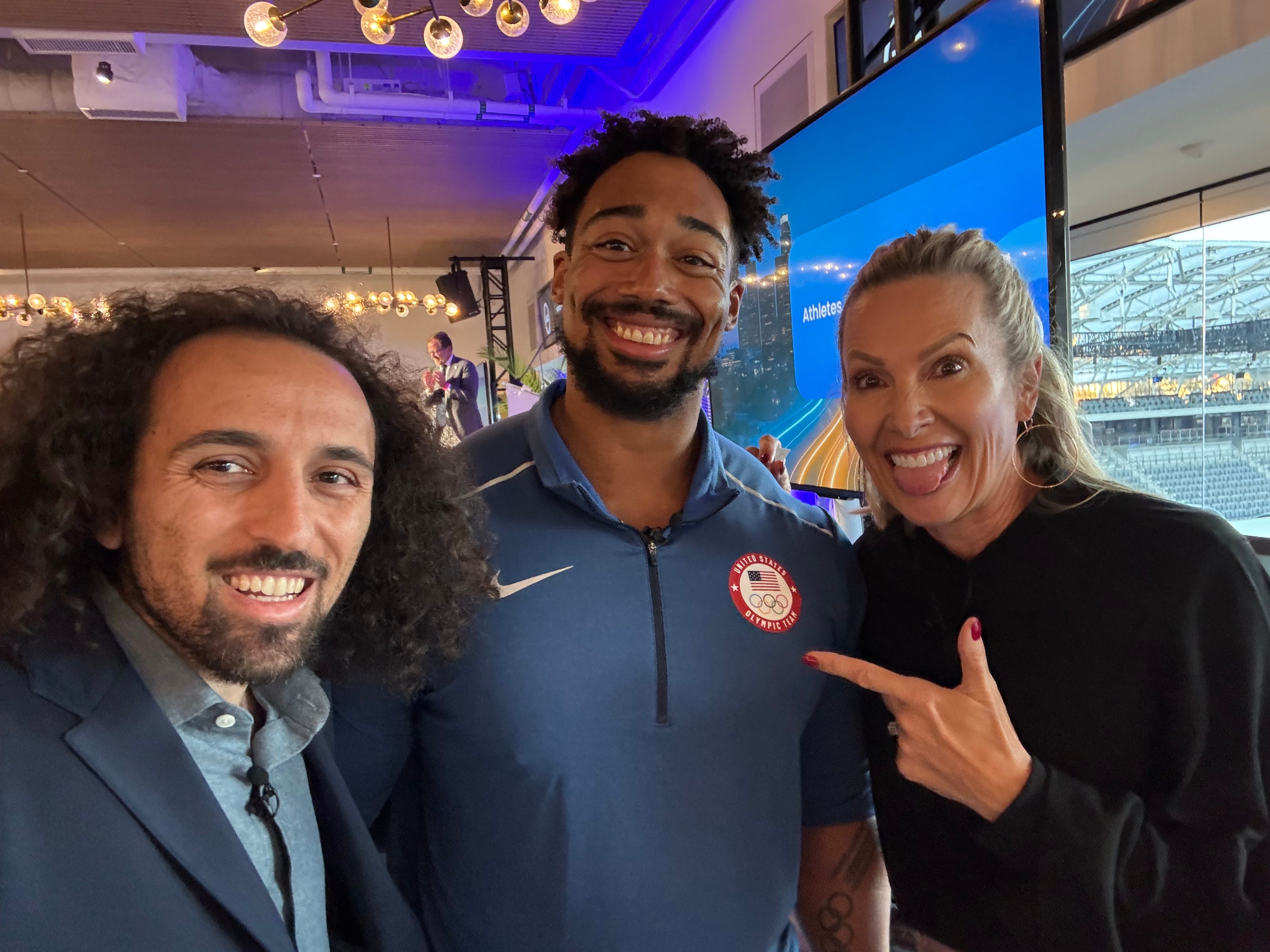
Last week, I had the privilege of sitting down with two decorated Olympians at Los Angeles’ premier soccer field, BMO Stadium, and asking them how the climate crisis has affected their lives.
At a packed event space overlooking the field, cyclist and plant-based food advocate Dotsie Bausch — who won a silver medal with Team USA in London in 2012 — and American discus thrower Sam Mattis, who placed 8th in Tokyo in 2020, talked about playing through extreme heat and wildfire smoke and toxic air pollution. They shared their perspective on why it’s crucial for L.A. and other cities to invest in clean energy, electric vehicle charging and public transit.
“We’re not going to have the fresh water to surf in or swim in, and we’re not going to have the snowcapped mountains to ski or snowboard on,” Bausch said.
The previous day, FIFA had announced that all games in next summer’s 2026 World Cup — including eight matches at L.A. County’s SoFi Stadium — would for the first time include three-minute hydration breaks during each half, to protect players from potentially dangerous temperatures.
“If you love sport and want to protect it, you have to act now and urgently,” Mattis said. “Sport is going to look a lot different. But there’s a threat of certain sports just not being able to be contested. Especially in more disadvantaged areas, you might not be able to play certain sports, because you don’t have the infrastructure to cool people down.”
See above for a video of our conversation. It was part of the “Road to 2028” summit hosted by the Los Angeles Cleantech Incubator, a nonprofit working hard to bolster the region’s clean transit options — light rail, electric buses, EV charging stations, etc. — ahead of the 2028 Olympics. NBA star Russell Westbrook recorded a video for the summit. Acclaimed actors Brian Cox (“Succession”) and Edward Norton spoke too.
I left feeling hopeful: Global warming was still big and overwhelming, but influential people were fighting the good fight, Trump be damned.
Then I went home and read the news.
One of the summit’s featured speakers had been Uber’s head of sustainability policy, Tessa Sanchez. She spent her time on stage touting the rideshare company’s extensive efforts to help drivers switch to electric cars. Two days later, Bloomberg reported that Uber had discontinued its monthly EV bonuses for drivers. Actually, the company had been retreating from its clean energy commitments for a while; it supported President Trump’s recent budget bill, which killed federal EV tax incentives.
I also read an L.A. Times story about the city of L.A. — a sponsor of the Road to 2028 summit — arresting a safe-streets activist who tried to make a Westwood intersection safer for non-drivers by painting a crosswalk. Technically illegal, morally laudable. It seems city officials were too busy to paint the crosswalk themselves, but not too busy to arrest someone doing it for them. As Paul Thornton wrote for Golden State Report, “You couldn’t dream up a more fitting way to mark L.A.’s decade-long failure to make life less dangerous for pedestrians and cyclists.”
But nothing deflated me more than this Politico story about the California governor’s race. The key takeaway was that none of the candidates are eager to talk climate; even billionaire Tom Steyer, who wrote a compelling book last year about how to “win the climate war,” has apparently fallen victim to the pollster-driven wisdom that focusing on climate makes you sound out of touch with the affordability concerns that are top of mind for most voters these days.
As current governor and aspiring president Gavin Newsom told Politico: “There’s not a poll or a pundit that suggests that Democrats should be talking about [climate].”
On the one hand, talking about affordability rather than climate isn’t necessarily bad. The two are linked, after all: Solar and wind are cheap! Democrats in other states have been winning elections recently by pitching clean energy as a solution to rising utility bills, even when they’re not saying the words “climate change” super often.
On the other hand, there are lots of voters who care deeply about climate! A minority, perhaps, but a passionate one. And as I argued last week, our hyper-fragmented media landscape makes it easy to target different people with different messages. Politicians who avoid climate because pollsters or pundits tell them it’s a bad look are missing an opportunity: Find the climate voters and show them you have a plan.
Unless you don’t have a plan, in which case they’ll figure it out.
Having a plan should be the bare minimum. Because — to paraphrase Bill McKibben — physics doesn’t care about politics. Carbon and methane emissions will keep doing their thing, regardless of how popular it is to campaign on climate. Even in the likely event that humanity doesn’t slash emissions nearly in half by 2030 — which scientists say is needed to limit global warming to 1.5 degrees Celsius — every bit of additional warming avoided means less death and destruction.
Some weeks feel darker than others. The more I can hang out with thoughtful, action-oriented climate advocates like Dotsie Bausch and Sam Mattis, the better.
Onward to 2028. We have work to do.
Live event: Podcast recording at UCLA
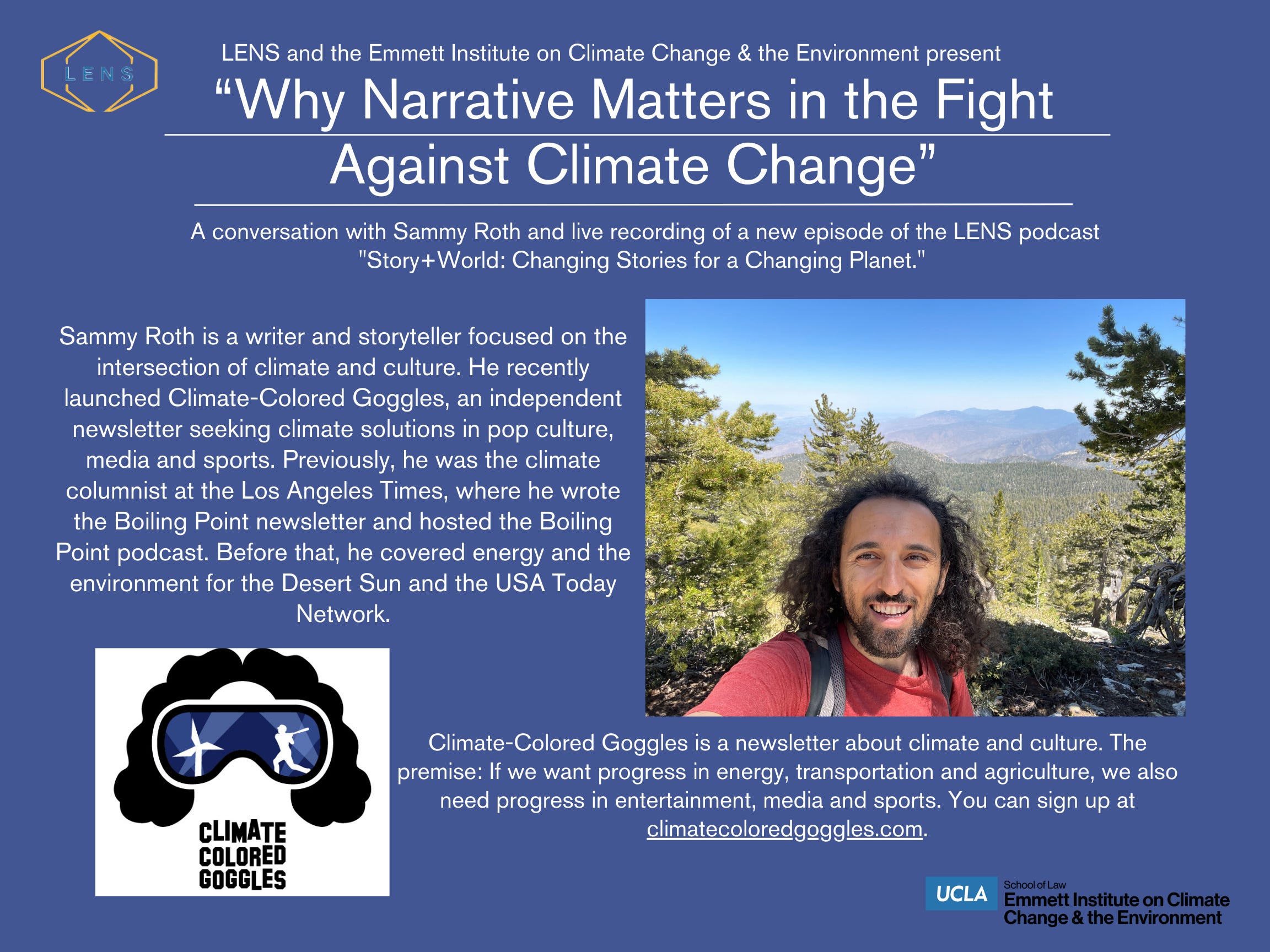
If you’ll be in the L.A. area the morning of Friday, January 9, feel free to join me in Westwood! I’m recording an episode of the LENS podcast from UCLA’s Laboratory for Environmental Narrative Strategies. The subject matter: “Why Narrative Matters in the Fight Against Climate Change.”
You can RSVP here. The recording runs from 10 a.m. to 11:30 a.m.
Also, if you missed the recent Zoom event about climate journalism and protecting a healthy democracy, the full video is posted here. In addition to me, panelists included environmental activist Bill McKibben and climate reporter Adam Mahoney. The event was hosted by Third Act SoCal and Covering Climate Now.
In other news
On our public lands:
The National Park Service is dropping free admission on MLK Jr. Day and adding it on Trump’s birthday. No, this is not The Onion. (Kylie Mohr, SFGATE)
The park service is also adding Trump’s face to the “America the Beautiful” park pass, which experts say may be illegal. (Amanda Heidt, SFGATE)
A top Interior Department official has financial ties to the Thacker Pass lithium mine in Nevada, of which the American people are now partial owners thanks to the Trump administration. (Jimmy Tobias and Chris D’Angelo, Public Domain)
More Trump stuff:
Federal officials have approved one solar farm and no wind farms on public lands this year amid a “national energy emergency.” (Nichola Groom, Reuters)
How did an obscure libertarian gadfly help bring the offshore wind industry to a screeching halt? Here’s the weird tale. (Clare Fieseler, Canary Media)
A judge struck down Trump’s wind farm ban. That doesn’t necessarily mean new projects will get approved. (Hayley Smith, L.A. Times)
Data center central:
A mysterious techno-cowboy rode into rural New Mexico with an impossibly big data center proposal and won local approval over howls of protest — then actually secured OpenAI and Oracle as customers. (David Segal, New York Times)
Hundreds of environmental groups want Congress to halt new data centers, citing energy and water consumption. (Oliver Milman, the Guardian)
California energy:
The Diablo Canyon nuclear plant received approval from the Coastal Commission to keep operating through 2030. (Hayley Smith and Noah Haggerty, L.A. Times)
America’s largest all-electric hospital opened last week in Orange County. Here’s how it works. (Ingrid Lobet, L.A. Times)
World of wildlife:
California officials have recommended state Endangered Species Act protections for Central Coast and SoCal mountain lions. (Lila Seidman, L.A. Times)
After 15 years leading the state Department of Fish and Wildlife, Chuck Bonham is joining the Nature Conservancy. (Kurtis Alexander, San Francisco Chronicle)
Finally, HEATED’s Emily Atkin and The Understory’s Miranda Green investigated the celebrity chefs who persuaded Gavin Newsom to veto a bill that would’ve banned nonstick pans with PFAS “forever chemicals.” It turns out all the chefs had financial relationships with companies producing and selling the nonstick pans.
Until next time
(For those of you coming to this post from social media, today’s social preview photo was by Gage Skidmore. It showed Tom Steyer speaking in Nevada in 2020.)
.jpg)
FYI - my piece on the race for Governor of New York and climate taking more of a back seat;https://www.climateandcapitalmedia.com/affordability-vs-ambition-new-yorks-2026-climate-collision-course/
Yeah the Tom Steyer thing has surprised me. Glad to hear some people, in some arenas, are talking about climate change!