

The case against climate cynicism
A new documentary offers a sincere but searing look at the small-and-struggling conservative climate movement.

Programming note: You may have noticed this is my third newsletter in three days! And I have more planned for later this week. If you can afford to support my work, please consider a paid subscription.
Here’s what I wrote the last two days:

When I sat down yesterday to watch “The [Conserv]atives” — a documentary about Republican climate advocates trying to convince their fellow conservatives to see the light — I was deeply skeptical.
I’d previously interviewed Utah Senator John Curtis, who founded the Conservative Climate Caucus before voting to obliterate renewable energy tax credits. I’d gotten to know California lawmaker Chad Mayes, whose decision to rescue the state’s signature climate program was so unpopular among Republicans that he lost his leadership post in Sacramento. For more than a decade, I’d heard folks insist that the conservative climate movement was finally on the verge of going mainstream, for real this time.
Now someone had made a documentary. Great. A trusted source was promoting it, so I figured I’d give it a shot. But I steeled myself to be irritated.
The first scene caught me off guard. It features Benji Backer, just 23 years old and the founder of the American Conservation Coalition, launching his group with a rally on a hot summer day in Miami. It’s pretty grim: Hardly anyone shows up, and protesters relentlessly interrupt Backer, with one shouting, “You’re all RINOs!” (Republicans In Name Only.) Another holds a sign reading, “There Is No Climate Crisis.”
Nadia Gill, one of the co-directors, told me this was the first scene she filmed. But she only realized well into editing that it was where she wanted to start the movie.
She decided it made for a strong opening, because (spoiler alert) not only does Backer fail to build widespread conservative support for climate action, the Republican Party arguably moves backward by the end of the film in 2025.
“The big dream of getting the Republican Party to shift — at that moment [in 2021] it seemed tangible, but by the end it seemed obsolete and impossible,” Gill said.
So no, this isn’t a naive, starry-eyed film. It’s wonderfully messy and instructive, and especially compelling (to my mind) for the access it offers to Backer and former Miami Mayor Francis Suarez, a climate-forward Republican who briefly ran for president in 2024. And it doesn’t shy away from the intense partisanship that stymies their efforts. Some of the best scenes include Backer sparring with climate denier Marc Morano in a debate, and Suarez being excluded from a Republican presidential debate — only for the debate to devolve into a climate denial lovefest.
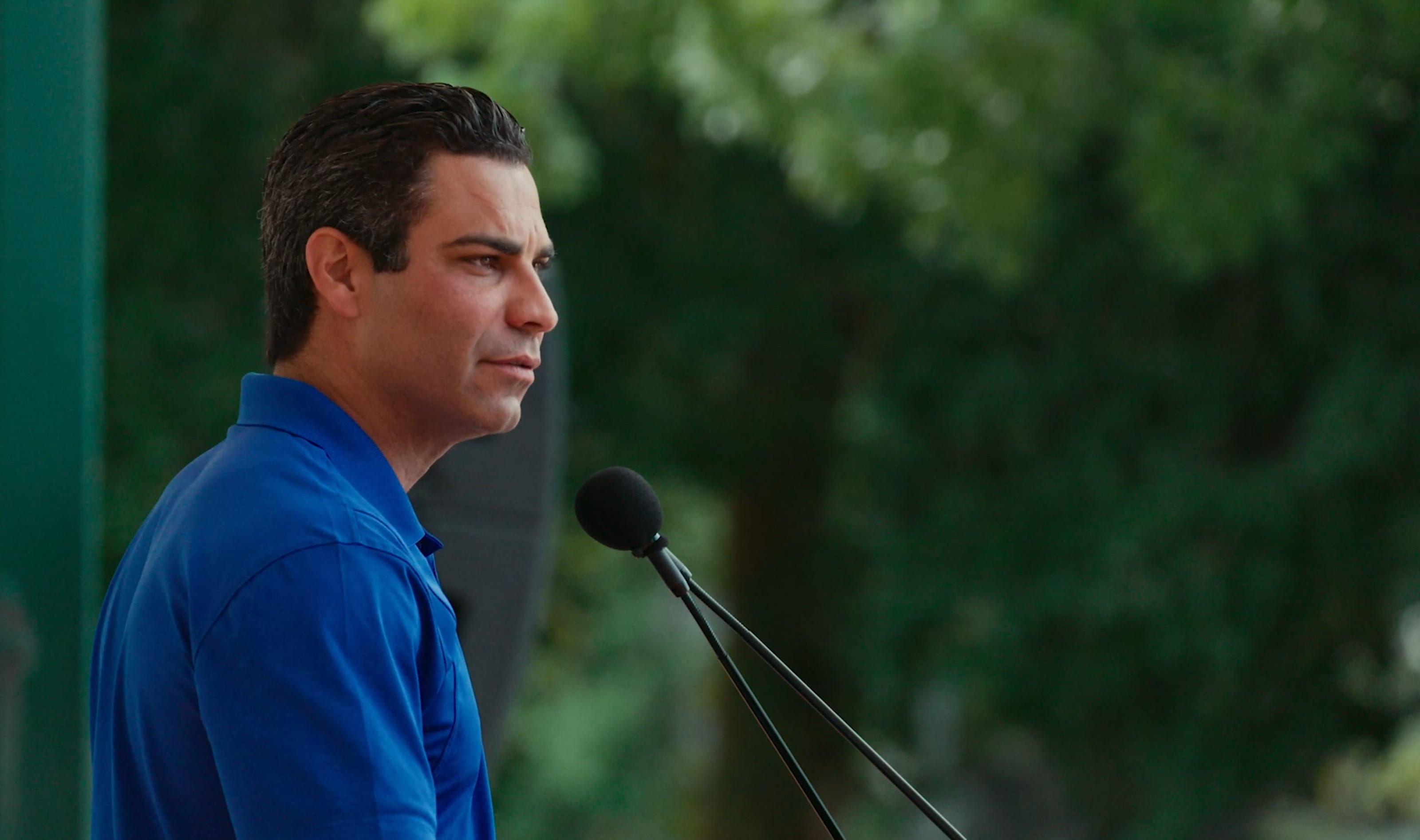
The ending is fascinating. Suarez ultimately endorses Trump. Backer falls the other way, becoming so disenchanted with the GOP — and with political polarization writ large — that he’s not sure he wants to run a conservative environmental organization anymore. He starts a new group called Nature Is Nonpartisan.
Gill called Backer’s transformation “the saving grace of the movie.” She made the film with center-left and center-right audiences in mind, and she worried they would come away feeling cynical if the events of 2024 and 2025 — Trump’s reelection, the “One Big Beautiful Bill” undoing President Biden’s climate law — didn’t force Backer to rethink his choices.
Not that Gill didn’t experience bouts of cynicism herself. Over four years working on the movie, she watched as congressional Republicans toyed with climate policy ideas, to the point where she wondered whether she might “capture the moment” when they finally took decisive action.
Then Trump got elected.
“I was kind of like, ‘Oh my God, why did I make this film? I need to throw it out. But I can’t,’” she said. “Think about Ray, think about Benji, think about Jessica.”
Ray Gaesser and Jessica Moerman are the other conservatives featured in the movie. He’s an Iowa corn and soybean grower, and an advocate for climate-friendly farming. She’s president of the Evangelical Environmental Network, and a believer that caring for God’s creation (including humans) is the Christian thing to do.
Watching the film, I was frankly a little bored by their stories, relative to the national political drama playing out with Backer and Suarez. But Gill saw their work as central to her message. The federal government is broken, she said; the path forward is local. Planting cover crops, like Gaesser. Persuading your neighbors to organize for climate action, like Moerman. Advocating for a community solar installation, like Gill herself is doing in Truckee, California.
“Is it a little mealymouthed or wishy-washy to say, ‘Go to your local community?’” she asked. “If you remain cynical, then yes. But if you don’t remain cynical?”

I’m an optimist, or I wouldn’t bother writing about climate. But I also struggle with cynicism. Of course we need local action, but how much will it matter in the absence of major national action? Of course we need Republicans to get on board, but can the climate really wait for them to get their act together?
As far as Gill is concerned, there’s simply no substitute for the slow, methodical work of building support for climate solutions in your local community, among people of all ideologies. That’s the only way to build a durable bipartisan consensus.
“We spend so much time looking at the legislators and the legislative failures, and not enough time just activating ourselves,” Gill said.
She’s right; we need lots more people activated on both sides of the political aisle. That’s the only way to get Democrats to take aggressive climate action at the federal level, and to get Republicans to stop repealing it whenever they retake Congress. We need an overwhelming groundswell of grassroots demand.
Right now we’re nowhere close. But I choose to be optimistic, because cynicism is self-defeating. Please, if you can help it, don’t ever be cynical.
Case in point: The idea of a climate-conscious Republican Party may sound ludicrous. For now, it is ludicrous. But eventually it won’t be. We can’t let it be.
Information about future screenings of “The [Conserv]atives” can be found here.
I’m part of a group called Citizens’ Climate Lobby which is a nonpartisan organization that seeks to find common ground between conservatives and progressives on environmental issues. No matter who is in the White House or who controls Congress, we’re there writing, calling and speaking directly with legislators about bills that will expand and upgrade our electrical grids or manage our forests or advance battery storage technology. We’ve got to keep blowing on the embers of conservative action on climate in hopes that they’ll ignite.
I've had this film on my watch list since I first heard about it from Nadia. It sounds like it offers an interesting contrast with The White House Effect (available on Netflix), which looked back at a brief moment in history (late 1980s) when the two parties were actually competing against each other to be the most aggressive in dealing with climate change (or global warming, as they used to call it).
Obviously we know how things turned out, with one party completely captured by the fossil fuel lobby. But these things do have a habit of moving in cycles. Eventually we'll come out the other side and have bold policy ideas again. At least that's what the optimist in me wants to believe.