


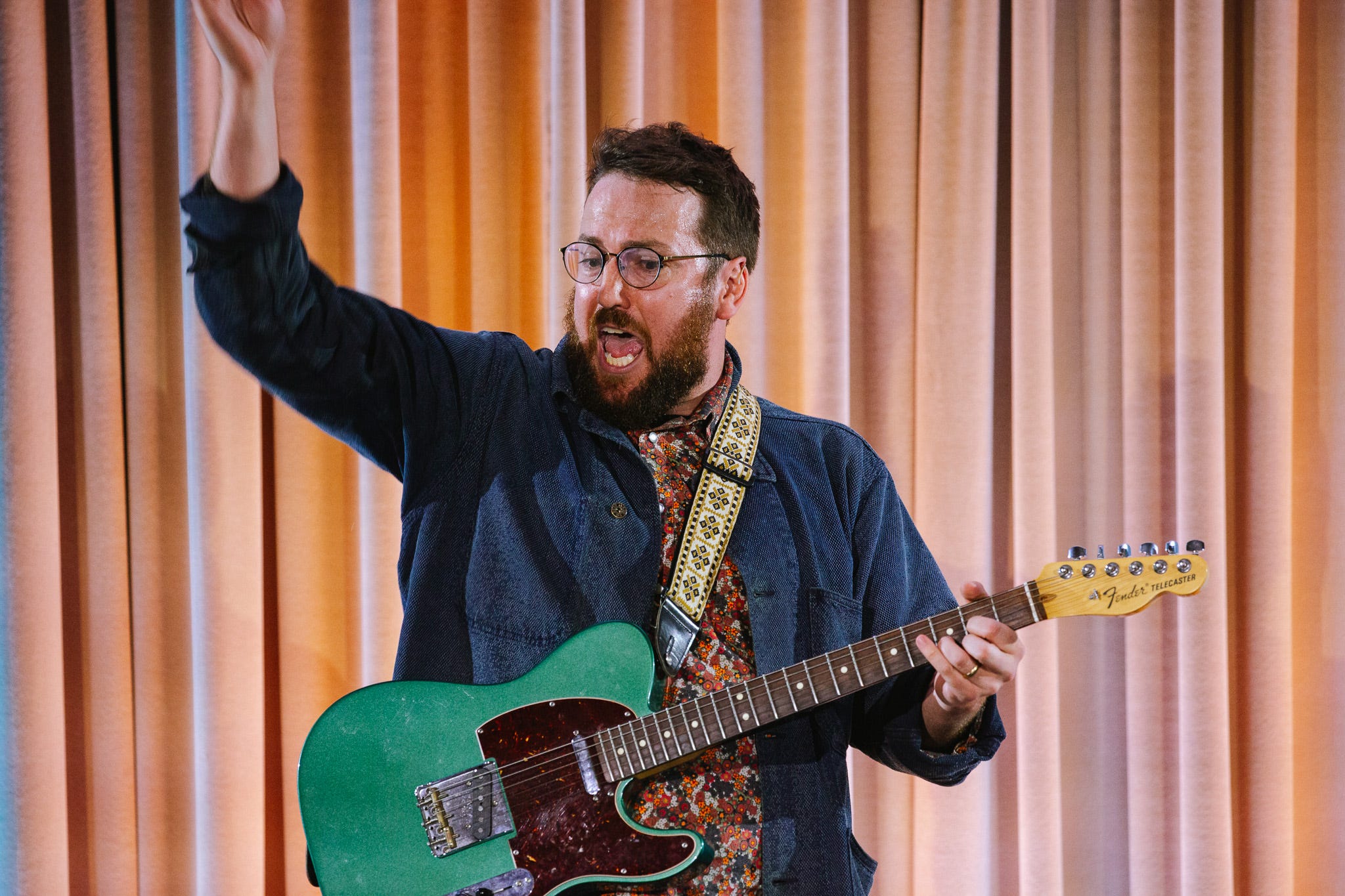
Brad Einstein was going for the comedy jugular. As he paced the stage at the Hollywood Climate Summit — a guitar around his neck and sweat coating his face — he had the crowd cackling with a bit about how they’d probably gone into climate work because they watched “FernGully: The Last Rainforest” at a formative time in their lives “and had a sexual awakening to the smog monster.”
“I know you nasty freaks, you don’t have to feel bad about it. It’s voiced by Tim Curry, it happened to all of us,” he said.
Einstein’s own path into climate work, he continued, was “a little weirder.” He was doing comedy in Chicago, and to make ends meet, he took a job writing tweets for an anonymous energy company. Only when he showed up for his first day did he learn that the company was “one of the largest oil conglomerates in the world.”
The oil giant made him sign a nondisclosure agreement, he said, so he couldn’t share who it was.
“And that sucks,” he added. “Like, that sucks worse than when you break up with someone, and then they call you on your cellphone looking for closure — because as we all know, there’s nothing worse than dealing with an ex-on-mobile.”
Big laughs. (Exxon Mobil, get it?!) Einstein wasn’t worried about the NDA anymore. But to be safe, he made everyone in the audience agree not to “narc.”
What would narcing look like? Well, he’d done this same routine a few years ago at a show in Santa Monica, and it turned out a reporter from the Los Angeles Times was in the crowd. Bad break for Einstein. Not only had the two-faced reporter broken the “no narcing” rule, the idiot had printed the joke in the L.A. Times. He had even asked Exxon for comment.
“When this came out, I lost my mind,” Einstein said.
In my defense — yes, it was me — I ridiculed Exxon’s dumb response to Einstein’s joke. I figured one of the world’s biggest climate villains would have zero sense of humor. I was right!
Still, I get why Einstein was rattled. After my story published, he texted a buddy, “Am I going to get Michael Clayton’d?”
“He very calmly was like, ‘No, you’re fine, no one cares about you,’” Einstein told Hollywood Climate Summit attendees.
By this point, the audience was rolling. But before revealing why he was holding a guitar — Chekhov’s guitar, he slyly deemed it — Einstein needed to narc on me.
Yes, the journalist who’d tattled to Exxon had dared show his face at this very summit — more laughs. But it turned out I was an OK guy. I was a quality journalist, after all. And journalism was important. In fact, big round of applause for journalism.
Einstein was one of the highlights of a delightful evening at my favorite climate conference. Months later, I’m still thinking about the comedy show — and not just the jokes.

Much as I love practicing written journalism, its power as a tool for education and persuasion is waning. Fewer people read. Fewer people are convinced by the things they read. Increasingly, when people do read, they’re skimming snippets on social media — or AI summaries. Getting people to click a link has become much harder during my 12 years in media.
This isn’t just a “young people” phenomenon. Watching the Season 4 premiere of “Ted Lasso,” I was jarred by a scene featuring two middle-aged characters, soccer team owner Rebecca (Hannah Waddingham) and her her trusty executive Higgins (Jeremy Swift). Higgins asks her, “Did you hear the news?”
“What, about the new Hermès collection?” she responds.
He gives her a knowing look.
“We have very different TikTok algorithms,” he says.
It’s art, but it’s imitating life. There’s a reason the Associated Press is now partnering with social media content creators to bring its climate reporting to more people. The first collaboration, a two-minute video about seaweed blooms — created by Summer Dean, aka @climatediva, who has 119,000 Instagram followers — is a perfect example of how legacy newsrooms can and should adapt.
Short-form video isn’t a silver bullet, though; we need all hands on deck to confront the climate crisis. That’s why I keep harping on about movies and TV shows, even theme park rides, that help people understand what’s at stake and how they can help.
Consider comedy another tool in the climate information arsenal.
“Comedy isn’t meant to be a replacement for news reporting,” said Max Boykoff, a University of Colorado Boulder environmental studies professor. “This is meant to be seen as a complement.”
Boykoff helps run the Media and Climate Change Observatory, which tracks climate coverage across legacy news outlets. (U.S. coverage has fallen sharply in recent years, even as global warming impacts have gotten worse.) He also teaches a class called Creative Climate Communication, where students learn different ways of thinking and talking about global warming — including through comedy.
“Certain people gravitate toward scientific ways of knowing. Other people gravitate toward emotional ways of knowing,” he said. “Especially young people.”
Boykoff pointed to a global survey finding that young people want their news to be more fun. He cited “The Daily Show” and “The Colbert Report” as early examples — and the conservative “Gutfeld!” as a more recent example — of young people “looking to comedy for their news and information.”
That’s why Boykoff was at the Hollywood Climate Summit. His students had been honing their comedy chops with professional comedians — and sometimes helping the comedians hone their climate chops. And now, four students were at the summit to perform their own sketch alongside the pros.
If Chloe Hull was nervous, I couldn’t tell. Before the comedy show, the newly minted college graduate was poised and confident. She told me she had no idea what she was getting into when she signed up for Boykoff’s class, only that she needed the credit to finish her environmental studies major.
“I walked into the [theater building] on the first day and immediately was like, ‘This is not the place for me. I need to leave, I need to drop this class,’” she said.
By the end of the semester, Boykoff and his fellow instructor, theater professor Beth Osnes-Stoedefalke, had helped Hull overcome her stage fright. They taught her how comedy can “break through people’s shells” — an especially valuable lesson for Hull, who grew up in the traditionally conservative military town of Colorado Springs.
Case in point: When Hull started at CU Boulder, her parents thought climate change wasn’t real — just media fearmongering. Now they “at least acknowledge the fact that it’s a problem that needs fixing,” Hull said. Her newfound comedy skills were just part of the secret sauce, but she felt like they helped.
Boykoff’s class was also empowering for Hull personally.
After learning about climate change as a sixth grader, she spent years paralyzed by dread. But becoming an environmental studies major gave her agency. And she was glad she hadn’t graduated without studying one of the most effective tools for making the climate crisis feel more manageable.
“Comedy allows people to know more about the problem and the solution at the same time, and almost calls people to action instead of making them feel doom and gloom,” she said.
That was certainly my experience at the Hollywood Climate Summit, which offered a master class in climate comedy.
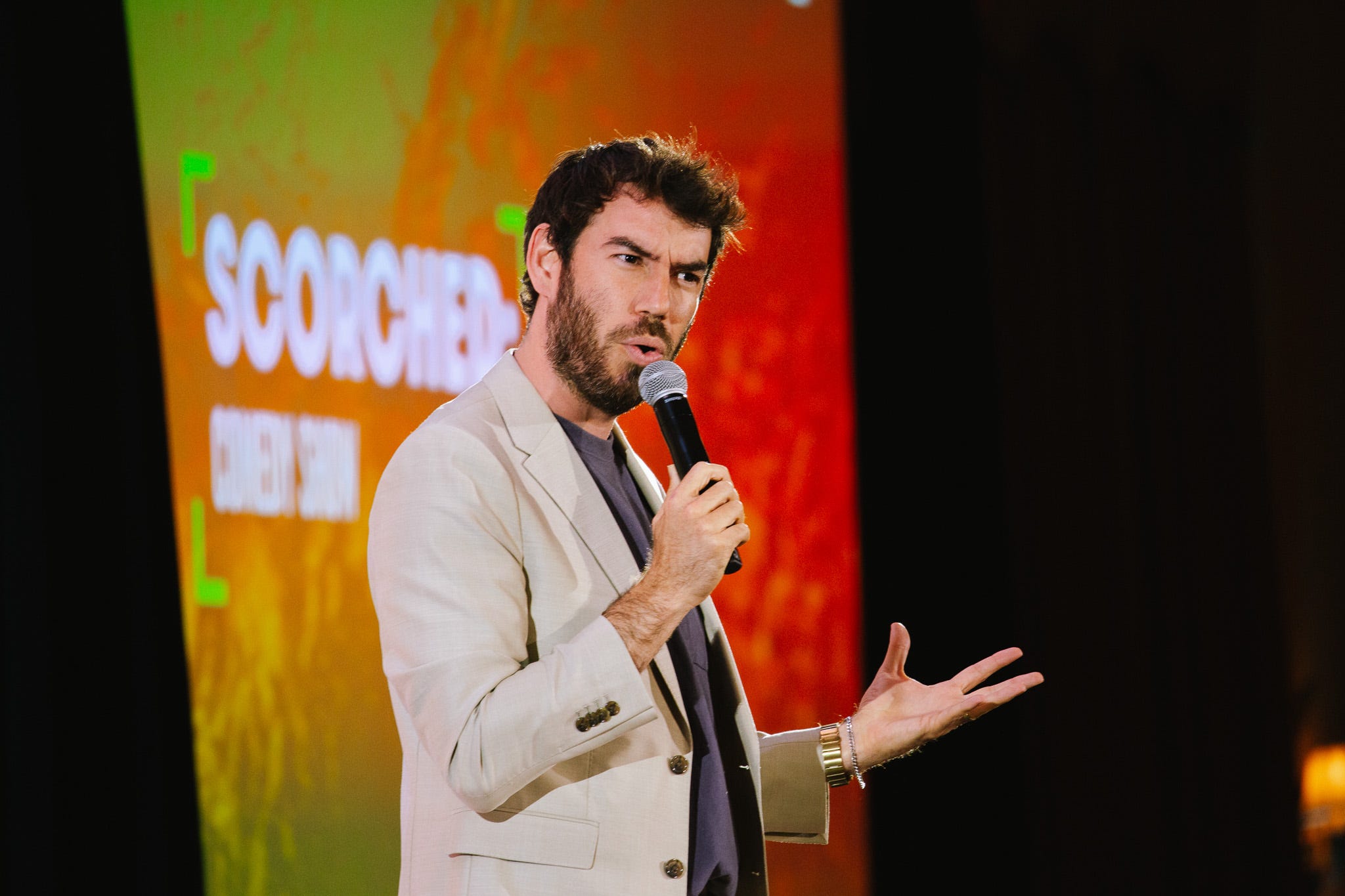
One of my favorite sets belonged to Esteban Gast, a Colombian-American comic who started off by poking fun at the audience for its limited Spanish language skills — a riff that segued into his discussing the history of U.S. military intervention in Latin America. A history that now includes President Trump’s attack on Venezuela, which Gast described as a “weird oil war.”
“They’re just coup-coo. Cuckoo for oil. It’s crazy,” he said.
A subtle, low-key punchline — and a perfect launchpad for Gast’s climate tirade. He said he got “radicalized young” when he ate at the jungle-themed Rainforest Cafe. He was confused by all the meat on the menu, since beef production is a major cause of deforestation (and thus climate change).
“I’m like, if you’re going to [sell beef], commit,” he said. “If you’re gonna do that, be like, ‘Sir, alright, you would like a hamburger? Perfect, let me just cut down that part of the restaurant, let me just’” —
He made a noise like a chainsaw, jerking his head for dramatic effect.
“You know? Just deforest your dining experience.”
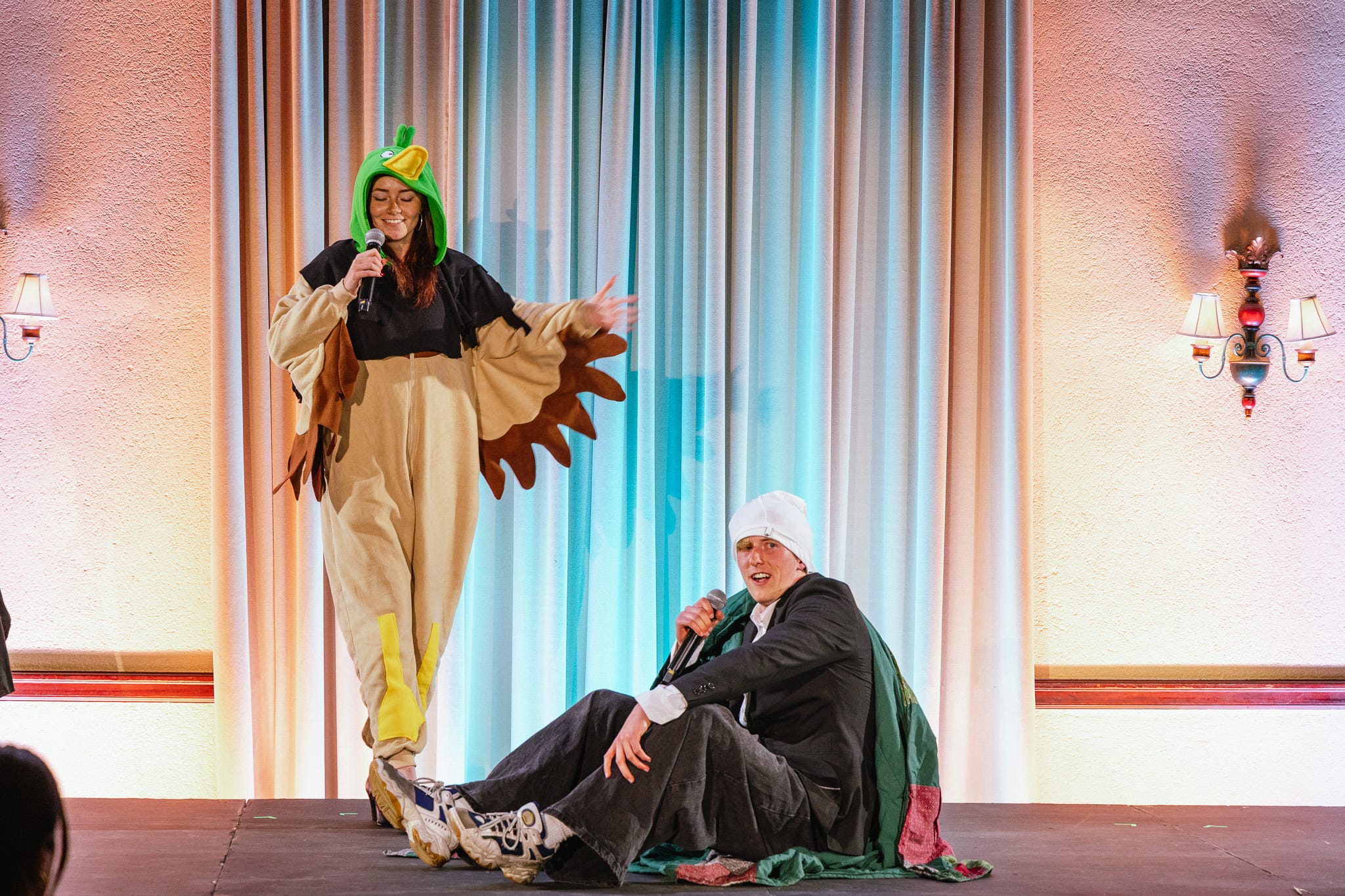
Although the CU Boulder students didn’t draw the biggest laughs (the pro comics were tough to beat), their sketch had a strong premise, about an oil titan haunted in his dreams by an oil-soaked bird, and by soldiers being sent off to war. The students had great stage presence. I hope they stick with it.
I also hope climate communicators of all kinds — journalists, comedians, scientists and more — think about how they can support each other.
After the comedy show, Einstein told me about a scene in his parody documentary, “Funeral for a Glacier.” During the funeral, he’s holding a bag of ice — the kind you’d buy at a grocery store — that’s supposed to represent a baby glacier.
“It’s a funny little visual gag,” he said.
He later talked with a leading glacier scientist, and he was startled when she “absolutely took me to task” for the baby glacier bit, telling him it was inaccurate because glaciers are frozen snow, not frozen water.
“I got off that call and absolutely disregarded that advice,” he said.
I’m with Einstein: In this case, it was fine to sacrifice a little accuracy for a good joke. Sometimes you have to laugh.
But facts are the foundation for everything; Einstein depends on journalists, scientists and other climate experts to inform his comedy. We all populate the same information ecosystem, approaching the same problem from slightly different perspectives.
So let’s collaborate. There are already universities and nonprofits that bring together comedians and climate experts; the more, the merrier. I’d love to help comics talk about climate. And if they can take my reporting and get it in front of audiences who would never otherwise read it? Even better.
My favorite part of the comedy show, by the way, was when Einstein slammed Exxon for bragging about how many women it employs in science, technology, engineering and math (aka STEM). Einstein roasted the tried-and-true greenwashing tactic on his guitar with the hilarious song “Women in STEM,” a rousing earworm about the fossil fuel industry hiding its misdeeds behind the mask of feminism.
I had heard Einstein play the song once before, and I appreciated it just as much the second time. He said he likes that “it’s educational, it’s funny [and] it punches up in a complicated way.” Just as important, the subject matter is evergreen.
“It’s not news. It’s not a thing that happened in the past week. But it’s interesting,” he said. “It will make you more media literate, and climate literate.”
Like journalism, but funny.
Haha! No, but seriously, comedy is such an undervalued communications tactic. It's obvious that more people look to comedy shows for their news and information. "The Daily Show" may have popularized the trend, but we also see it show up in how late-night hosts frame their monologues and in how online influencers engage with their audiences. A couple of well-timed laughs can go a long way in breaking down the wall that separates overwhelmed viewers from important news.
There was even a "FernGully" themed episode of "Rick and Morty" a few weeks ago called "MortGully: The Last Rickforest" -- which is worth a watch for entertainment value alone (although they do sneak in some excellent evolutionary biology references as well). I wrote about it on my Substack if anyone's interested in a deeper read. TLDR: we need more climate cartoons.
Btw, you should check out the work Jessie Bluedorn is doing at Carmack Productions. It's right up your alley!