

Car Culture, Part 1: The Battle for Disneyland
Should we drive electric vehicles or try to stop driving? "Life After Cars" meets the Happiest Place on Earth.

“Life’s like a road that you travel on / When there’s one day here and the next day gone” — Rascal Flatts, “Life Is a Highway” (2006)
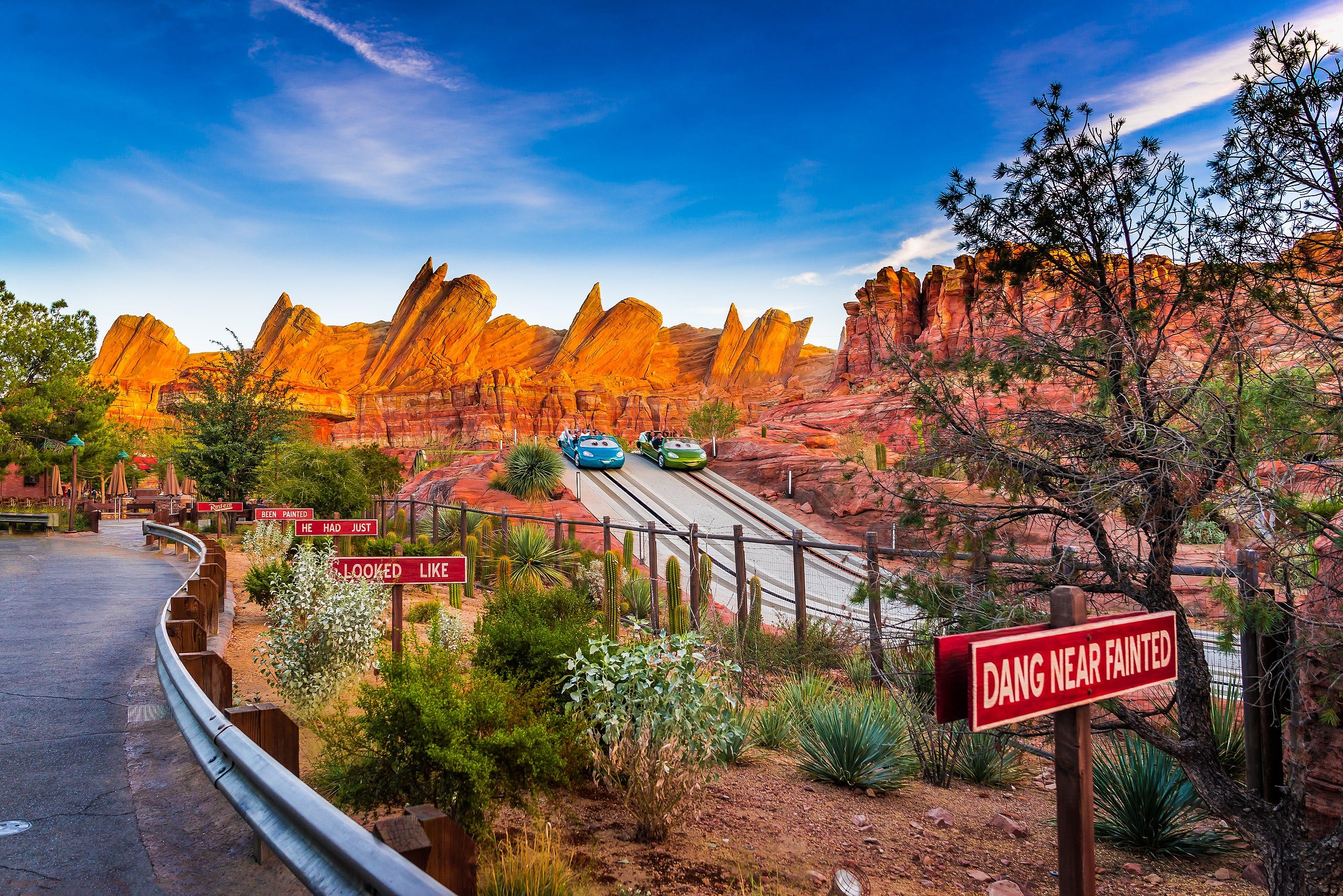

Next fall, Disneyland will deliver a seminal moment in American transportation history. Seven decades after the dawn of the freeway era, Disney’s Autopia attraction — an ode to car culture and the open road, and a Tomorrowland icon since 1955 — will begin its transformation from gasoline engines to electric motors.
Autopia is especially popular among kids. Soon they’ll learn that electric vehicles, not gas-guzzling pollution machines, are the way of the future.
Exciting as that day will be, the new-and-improved Autopia will arguably be Disney’s second-coolest work of car-themed storytelling in Anaheim.
That’s because Disneyland’s sister park, California Adventure, already reimagines our relationship with cars — by taking them off the road almost entirely.
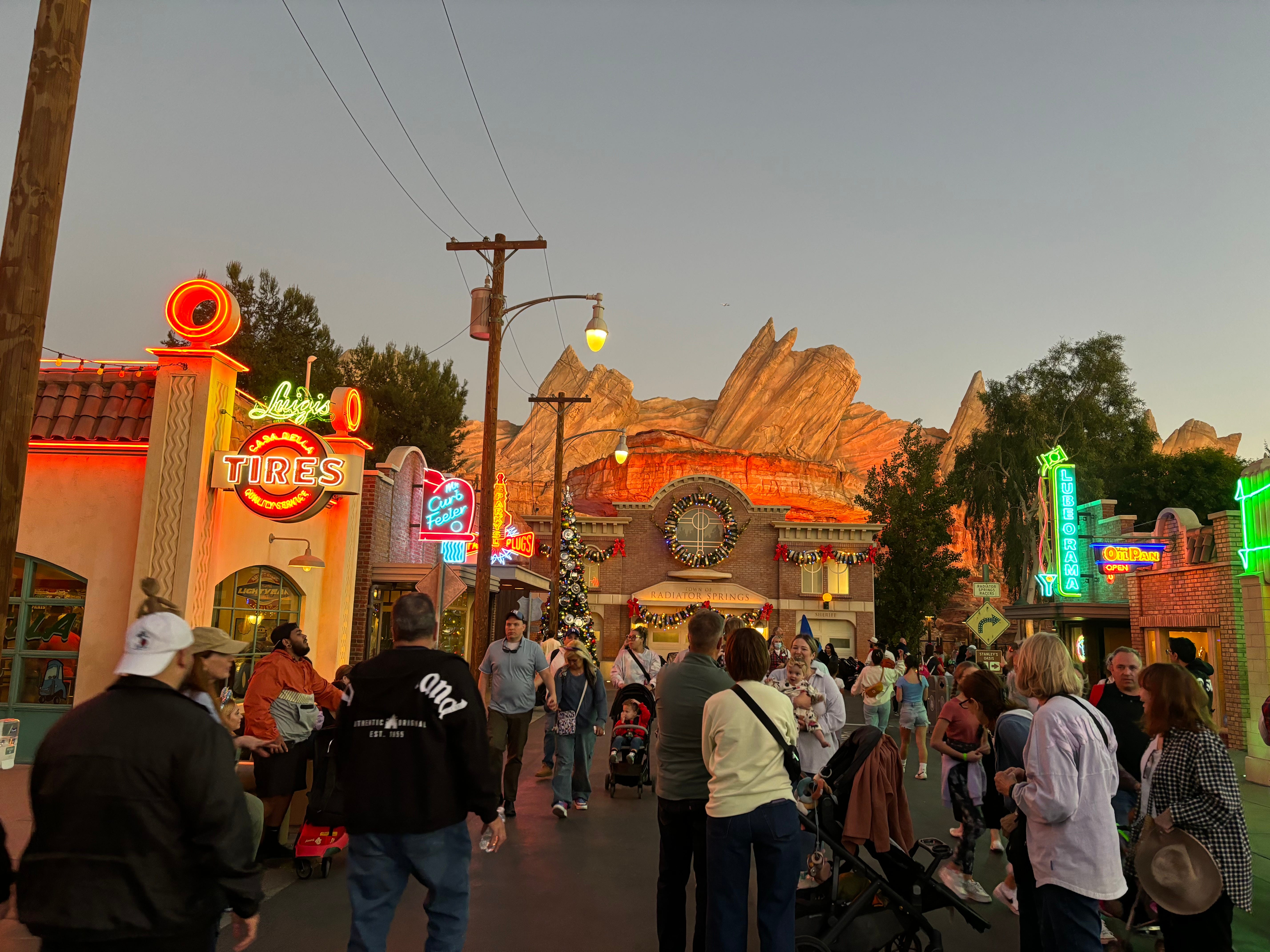
I’m talking about Cars Land, which recreates the Route 66 town of Radiator Springs from Pixar’s “Cars” films. Take a stroll through town and you’ll see quirky storefronts, retro diners and snazzy motels — backdropped by soaring red-rock cliffs. The lighting is gorgeous at night. The one traffic light always blinks yellow. There are benches and tables where you can relax and enjoy the ambiance. The town’s most famous residents, race car Lightning McQueen and tow truck Mater, pose for photos with guests.
Cars Land is one of my favorite places to spend time at the parks. Partly that’s thanks to the rides, especially a high-speed racetrack attraction topped with solar panels. But mostly it’s because Radiator Springs is pleasant and beautifully designed.
Or in the words of Doug Gordon, who co-hosts The War on Cars podcast: It’s a super walkable town that just happens to be built for talking cars.
“Storefronts face the street, no giant parking lots out front. Very quaint, ideal in many ways,” he told me. “It’s just that everything’s a bit wider to accommodate the cars.”
When he said that, my jaw dropped a bit. Much as I love Cars Land, I’d long harbored a faint annoyance at the fossil fuel design motifs: the gasoline pumps, the house of oil bottles, the oil can Christmas decoration. Meanwhile, no EV charging stations. No EV signage. Not exactly teaching kids the right lessons.
But Gordon made me reconsider.
Even after Autopia electrifies, maybe its 1955 vision of utopia — of motorists finding freedom and exhilaration in sprawling highways — should be less of a north star than this Route 66 oasis.
“It’s the most pedestrian-friendly town,” Gordon said.
When my polite rabble-rousing prodded the Walt Disney Company to agree to shut down Autopia’s gas vehicles by October 2026 — and eventually replace them with EVs — I was thrilled. To be clear, I’m still thrilled. Transportation is the largest source of climate pollution in the U.S. Any hope of staving off ever-more-dangerous heat waves, wildfires and storms rests largely in transitioning from oil to electricity.
And yet electric cars can still be harmful.
I’m not just talking about environmental harms from extracting lithium, cobalt and other metals for EV batteries. I’m talking about the problems inherent to all cars, gas and electric — and the ways our cities are designed to prioritize fast-moving vehicles at the cost of human health and safety.
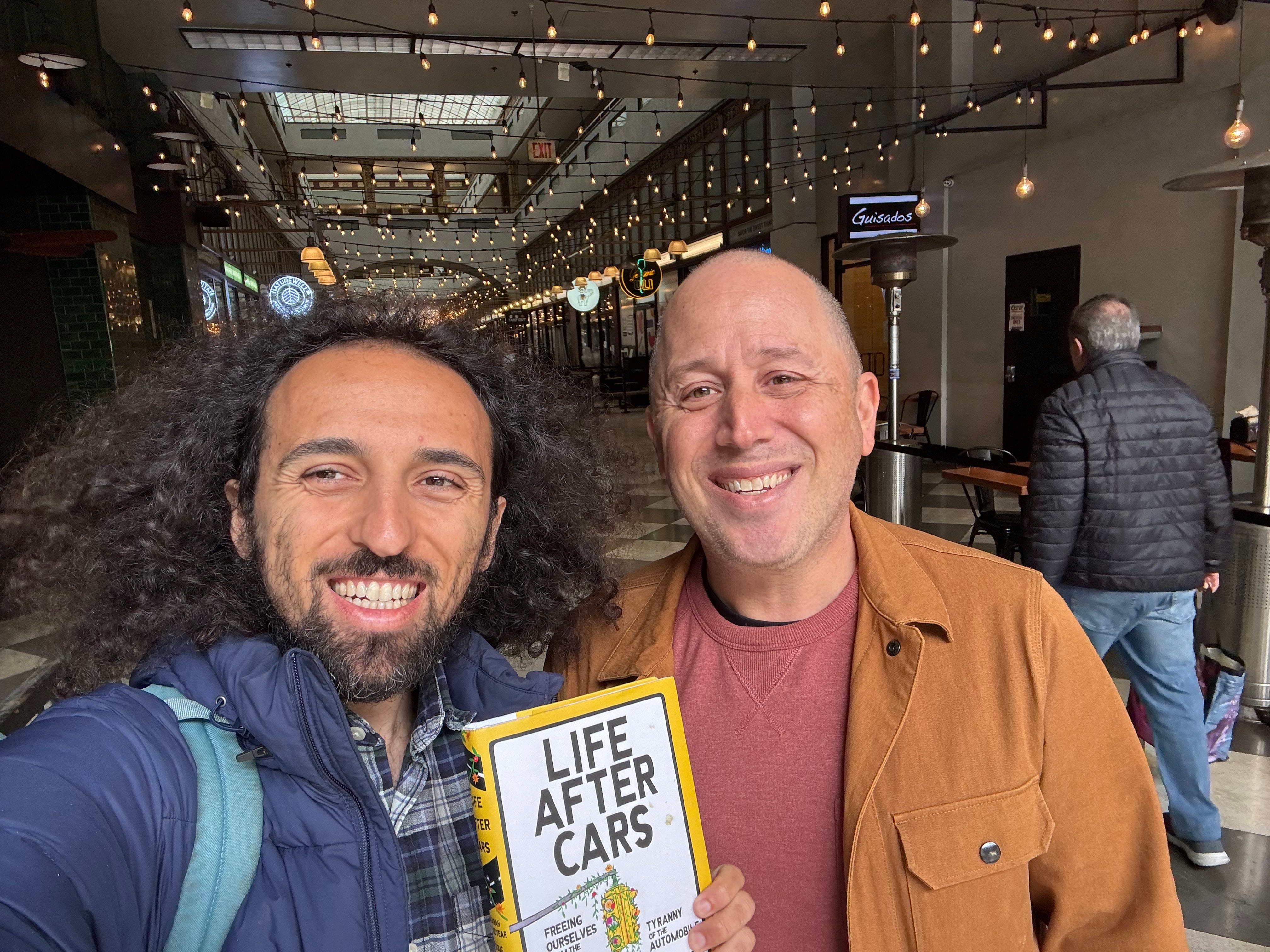
Those massive challenges are the subject of “Life After Cars,” a fascinating new book by Gordon, Sarah Goodyear and Aaron Naparstek.
“Just as water is invisible to the fish, hardly any of us can perceive the swirling sea of cars and car-centric infrastructure around us,” they write. “It’s just the world in which we’re swimming — or driving.”
It’s true. Before opening the book, I knew that better public transit, denser housing and safer bike paths were useful climate solutions. I also knew that vehicle tires shed microplastics and hazardous air pollution; that freeway construction has decimated communities of color; and that roughly 40,000 people die in traffic crashes in the U.S. each year. I even wrote a story about my friend Jim Pagels, who was killed by a driver while cycling.
Still, I was shaken by “Life After Cars.” The authors make a compelling case that cars degrade our lives in ways most of us rarely if ever consider.
For example? Many of us live in neighborhoods with plenty of hot parking lots but few parks or shaded sidewalks. Governments respond to clogged freeways by adding more lanes, even though researchers know this will only lead to more traffic. The idea of kids walking to school on their own — a rite of passage for Baby Boomers, and still common in other countries — is now practically unthinkable in many cities.
Except in remote places, you hear cars almost everywhere you go. You pay thousands of dollars for vehicle repairs because you have little choice — unless you can’t afford a car or can’t drive for medical reasons (which puts you at a disadvantage in a society built around cars). If you’re a person of color, the potential for racially biased policing may loom large when you’re behind the wheel.
And when you sit in traffic, you get angry. You treat people in ways you would never treat them face to face — a phenomenon brought to life in Disney’s 1950 animated short Motor Mania, starring Goofy.
That is a brief, insufficient summary of the many things I learned reading “Life After Cars.” At a lithe 233 pages, you should really get your own copy.
You may think the idea of “life after cars” sounds absurd. And frankly, it is. For most people in most places.
But Gordon isn’t an ideological purist. He’s a jovial guy from Brooklyn trying to prod society in a better direction. When we met up for breakfast last month in downtown Los Angeles— he was in town for his book tour — he acknowledged that reducing car dependence will be slow.
But he does think it’s possible, even in L.A. He’d like to see local officials get started in neighborhoods that are already fairly walkable, like downtown and Venice.
He suggested simple upgrades, like wider sidewalks and shorter crosswalks.
“Could you just fix it a little bit, so that people don’t have to use a car every single day and for every single trip?” he asked.
I wanted to support his ideas. But part of me worried that focusing on the ills of car culture would divert time and money away from arguably the world’s most important climate solution: electric vehicles. Did he share my concern?
No, he told me, he didn’t.
“You need all of it. I want the scientists and engineers at the Ford Motor Company to be working on the latest EV technology,” he said. “And I want the YIMBY movement trying to build dense, infill housing. And I want the cycling movement to be fighting for the bike lane. These are aligned missions. These are not zero-sum.”
After a few minutes of discussion, I decided he was probably right.
Replacing hundreds of millions of gas cars and trucks with electric vehicles is going to be wildly difficult, even as EV prices keep dropping. The elimination of tax credits by President Trump and congressional Republicans won’t help.
The fewer gas cars we need to replace, the lighter the lift. The more people get off the road — the fewer vehicle miles traveled — the easier the electrification math.
“In the places where you have no choice but to drive, we should be electrifying every car as fast as possible,” Gordon said. “Every time someone needs to buy a new car, it should be electric.”
And the rest of the time?
“In the places where it’s possible to enable car-free or car-light living, we should make sure everything about the built environment says, ‘I don’t need a car,’” Gordon said.
Which brings me back to a passion that he and I share: Disneyland.
I had visited the Happiest Place on Earth the day before Gordon and I met up. He planned to spend the next two days there. If his experience has been like mine, I’m guessing he’s grown accustomed to confused looks from fellow environmentalists who can’t understand why he loves Disneyland so much. Isn’t it, like, a crowded capitalist dystopia? Wouldn’t he rather go for a hike?
I won’t use this space to sing Disneyland’s praises. But I’ll share another of Gordon’s observations: that as much as some city-dwellers are loath to cede any land allocated to cars — curbside parking spots that could become bus or bike lanes; surface parking lots that could be developed into housing; downtown corridors that could be closed to motorists and opened to foot traffic — folks love spending time in car-free spaces.
Spaces like Disneyland.
“You think of the Grove or other places that people like to go to, ditch their cars and then walk,” Gordon said. “Even Angelenos understand that getting out of the car and just walking and experiencing other people is a nice and fun thing to do.”
Disney capitalizes on that. And not just at Cars Land.
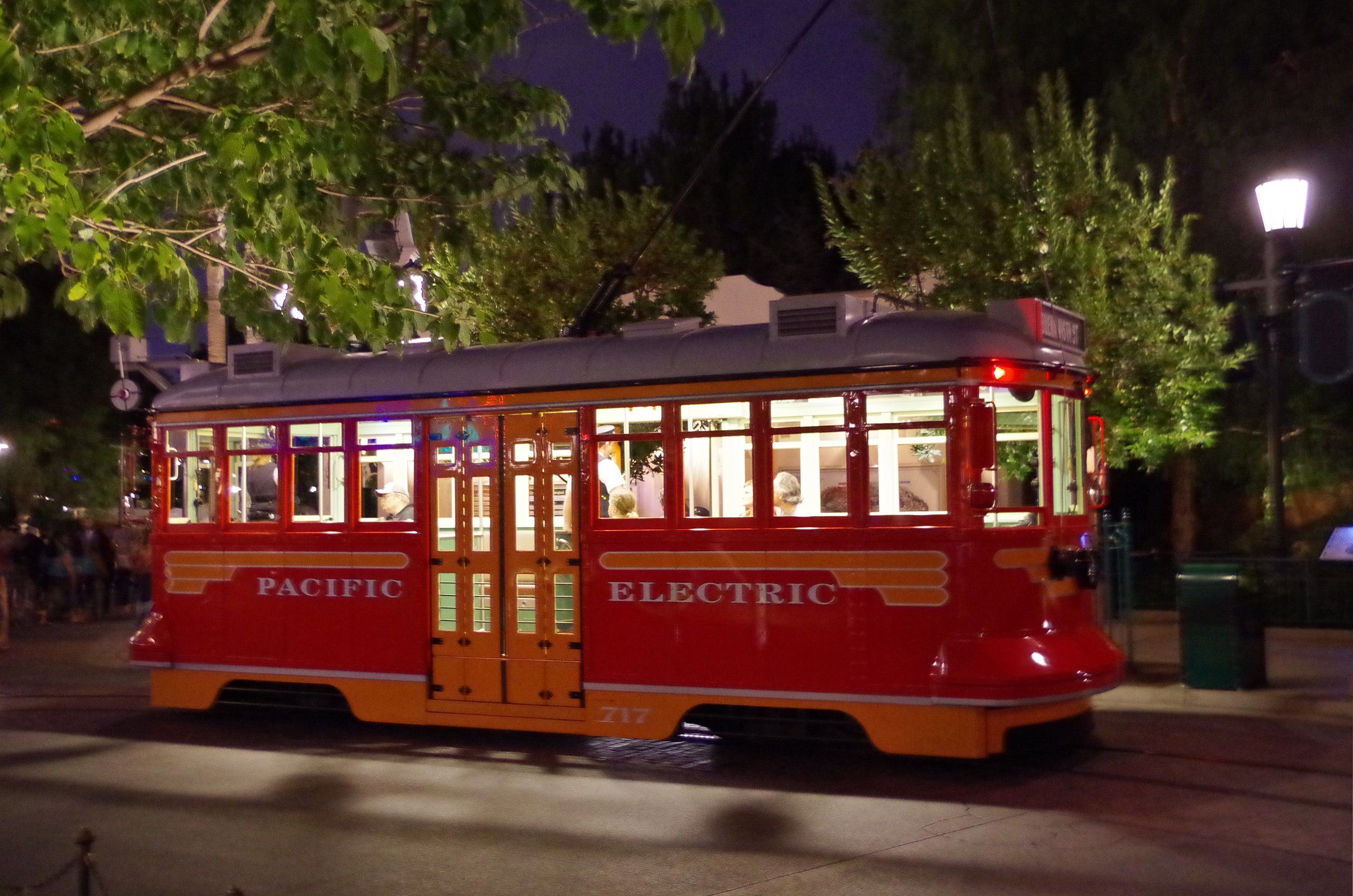
Once you pass through the gates, you enter a pedestrian-friendly, transit-oriented nirvana. Main Street, U.S.A., blends foot traffic with slow-moving vehicles, including a horse-drawn street car and a double-decker bus. Disneyland offers both a railroad and a Monorail. California Adventure features a Red Car Trolley modeled on L.A.’s long-lost electric street cars.

Sixty years ago, in fact, Walt Disney wanted to build an actual city promoting a new vision of American urban life — one centered on public transit. Walt’s Experimental Prototype Community of Tomorrow would have limited the need for passenger cars, prioritizing Disneyland-style monorails and PeopleMovers.
“Here the pedestrian will be king, free to walk and browse without fear of motorized vehicles,” says the narrator of an October 1966 video.
Also planned: “footpaths reserved for pedestrians, electric carts, and bicycles,” where kids could walk to school “completely safe and separated from the automobile.”
Alas, Walt died two months later, and his dream was never realized. EPCOT became a Florida theme park rather than a city. Autopia lived on.
Since then, Americans have walked on the moon, invented the Internet and pioneered artificial intelligence. Yet we’re still wedded to automobiles.
When I first wrote about Autopia last year, I spoke with legendary Disney Imagineer Bob Gurr, who designed the original ride vehicles. Then 92 years old, he was pleased to see Autopia electrify. But if he could, he’d tear down everything in Tomorrowland except the Monorail and build a new land resembling Walt’s utopian city.
“I worked with Walt for 12 years, almost in a feudal way, trying to get people to understand what he was going to do with EPCOT. And it just never came to be,” Gurr told me. “But it could be [a reality] in Anaheim someday, if somebody had the courage to take a deep breath and say, ‘We’ve got to fix Disneyland.’”
At the same time, Gurr is practical. He knows Autopia is staying put. And he knows a “real future” in Tomorrowland, at least for now, means electric cars.
“I’m 92 years old,” he said. “I’d love to live to 150 so that I can see it all.”
Stay tuned for Car Culture, Part 2, featuring news and observations from the LA Auto Show.
Appreciate your thorough coverage of the issues around driving, EVs, and their climate impacts.
I’d add a few tangents:
- Home hunters should check the walkability and bikeability scores on sites like Zillow or Redfin. Living where daily needs are within walking or biking distance can boost health, and more desires for these neighborhoods encourages infill and mixed-use development.
- Buying local can help reduce vehicle miles traveled and support the local economy.
- Encourage your employer to install EV chargers. From what I’ve seen, employees love the convenience of charging at work, which often encourages more coworkers to change to EVs, and HR tends to treat on-site charging as a recruitment perk.
Why do I share Sammy's initial instinct that "focusing on the ills of car culture would divert time and money away from arguably the world’s most important climate solution: electric vehicles?" Mostly because of the oil and gas industry's unmitigated, billion-dollar, multifaceted focus on getting each of us and our sons and daughters to use as much oil and gas as possible and at pace. My EV-activist community started advocating for EVs in 2002 because these zero-emission cars were....wait for it....ready! On the road! Available for purchase and increasingly so. Big Oil would fight to the end and hydrogen fuel cells were a distant possibility. And the climate clock was ticking. Our holy grail was to accelerate adoption. Yes, it is going to be a heavy lift to replace hundreds of millions of gas vehicles with EVs, but we can and must ramp it up right now--with immediate results. Every gas car off the road contributes to fewer asthma and cancer rates and a cooler planet. Rearranging our cities will take much, much longer, without such immediate effects. Today I preface every pro-EV statement I make by saying, "drive less," which I try to do myself. And no, it's not a zero-sum game. But, with that clock ticking, I can't in good conscience ignore this, as Sammy says: EVs are arguably "the world's most important climate solution," and "transportation is the largest source of climate pollution in the U.S." It's the world's second largest source. There are now more EV charge ports than gas pumps in CA, a new Nissan EV—with over 300 miles range—goes for $20k less than the average new gas car, and globally EV sales were up 25% last year. So yeah, let's do this now. It's my main focus.