


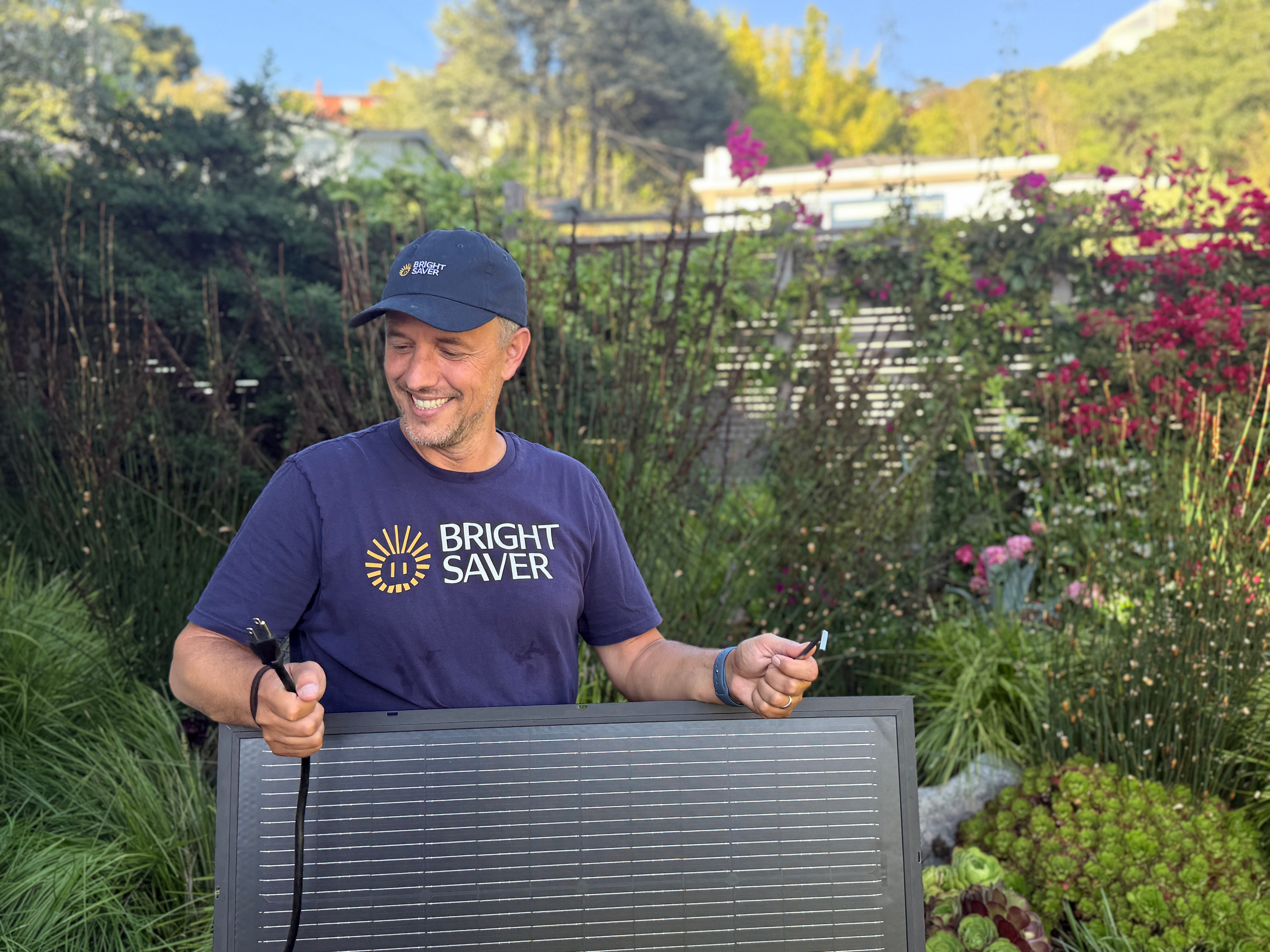
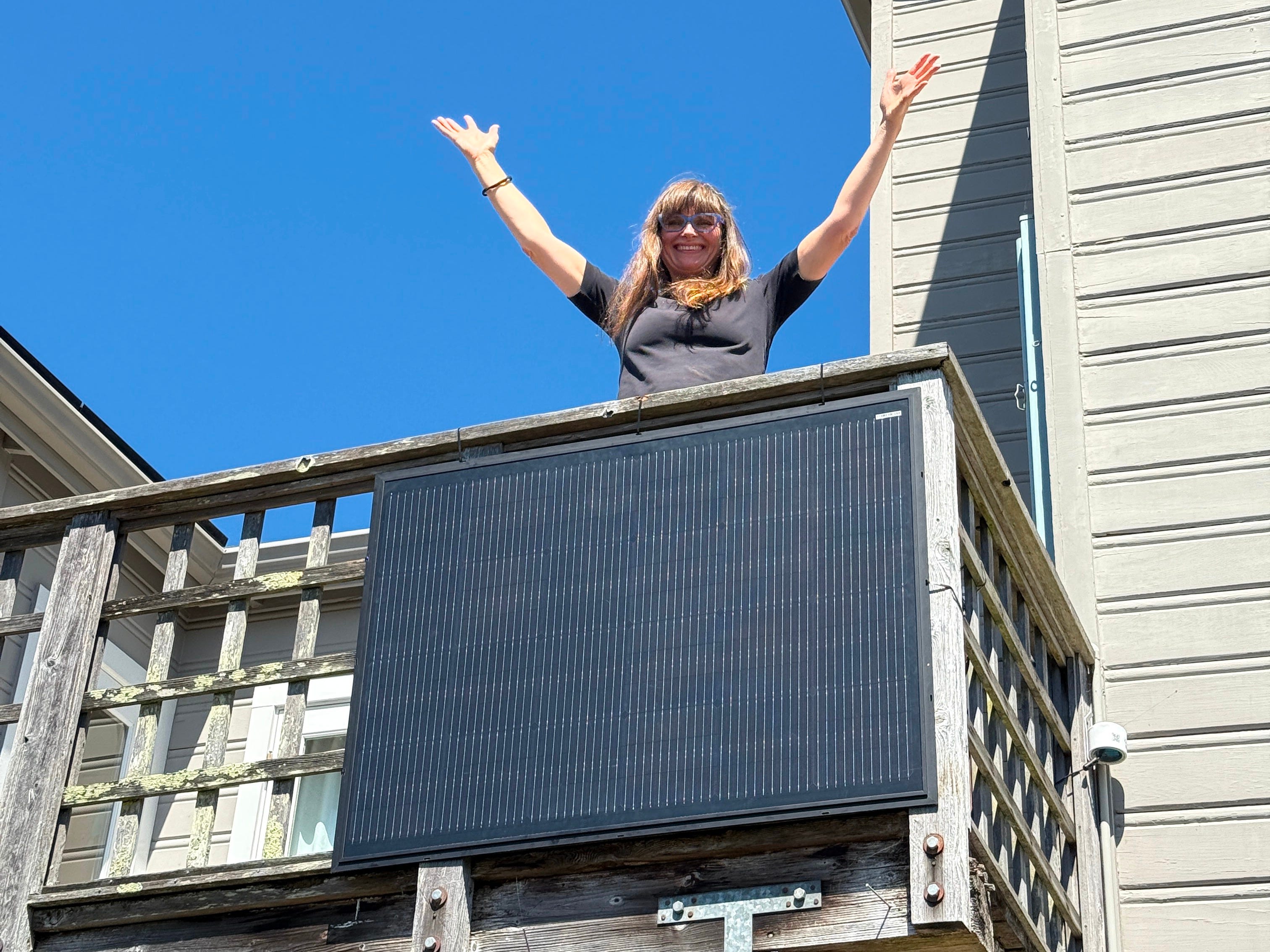
The California Legislature adjourns in 11 days, and lawmakers still haven’t passed a no-brainer bill — introduced back in January — that would make it easier for renters to spend a few hundred dollars on solar panels, plug them into a wall, drape them over a balcony and start saving money on electricity immediately.
What happened to the affordability crisis? And also the climate crisis?
The bill will probably pass — but only after a crappy last-minute amendment. And only after 11 other states have passed similar legislation.
What happened to California being a climate leader?
“It’s one of those bills where you’re like, ‘Wait, why didn’t we do this before?’” said Senator Scott Wiener (D-San Francisco), author of the Plug and Play Solar Act.
When I spoke with Wiener this week, he was feeling good. His legislation promoting plug-in solar, aka “balcony solar,” had sailed through the Senate months ago on a 35-1 vote. Now it was headed to the Assembly floor.
“This is a low-cost way for renters and homeowners to lower their energy bills and be part of the clean energy transition,” Wiener said. “It’s a game changer.”
The journey had been bumpy, though. A few days earlier, the bill had gone through the mind-bogglingly stupid and nontransparent “suspense file” process, which gives Sacramento power players an opportunity to kill or rewrite legislation via backroom dealmaking, with no explanation to the public.
Wiener’s legislation made it out alive but battered.
The key feature of Senate Bill 868 is that it would allow renters and homeowners to buy balcony solar panels from retailers like IKEA or Home Depot and plug them in without applying to their electric utility for an interconnection agreement — a costly and potentially time-consuming requirement.
But when the bill cleared the suspense file, it included a surprising new provision: the interconnection exemption would expire on January 1, 2030.
Meaning if you want to purchase plug-in solar panels after that date, you’ll need your utility’s permission — unless the Legislature extends the exemption.
“It’s a real bummer. It means that we’re going to have another fight ahead of us,” said Cora Stryker, co-founder of plug-in solar nonprofit Bright Saver.
Who lobbied for the 2030 sunset date? Although I don’t know for sure, I’ve reviewed correspondence showing that adding a sunset date was a priority for one of the bill’s most influential critics: Pacific Gas & Electric.
Yep, everyone’s favorite investor-owned utility is once again trying to suppress clean energy solutions that don’t boost shareholder profits. After years working to undercut rooftop solar — a successful campaign that helped prompt state officials to slash solar incentives — PG&E is gunning for balcony solar too.
Only this time, some of the company’s usual allies have jumped ship.
PG&E and its fellow utility giants, San Diego Gas & Electric and Southern California Edison, persuaded many politicians to oppose rooftop solar incentives with help from powerful electrical workers’ unions, whose interests tend to align with the utilities. If the utilities are profitable, it means a steady stream of high-paid union work.
But the unions decided not to fight plug-in solar. More than a dozen chapters of the International Brotherhood of Electrical Workers took neutral stances on Wiener’s bill, as did two leading union groups. Even Edison broke ranks, telling me that it no longer opposes SB 868 after the latest amendments.
Undeterred, PG&E and SDG&E have argued that balcony solar panels pose a safety hazard, in part because they could send small amounts of excess electricity onto the grid — energy that could damage equipment or zap unsuspecting electrical workers. A PG&E spokesperson told me that although the 2030 sunset date is helpful, “it does not fully address our concern.”
“Customers deserve the protections that come from clear safety standards … from the outset, rather than after several years of market adoption,” spokesperson Paul Doherty said in an email.
It’s not just shareholder-owned utilities opposing the bill. Two groups representing public power agencies — including the Los Angeles Department of Water and Power and the Sacramento Municipal Utility District — have raised similar concerns.
“It boils down to safety,” Derek Dolfie, senior director of energy for the California Municipal Utilities Association, told me via email.
I’m not a technical expert, so I can’t offer my personal judgment. But under Wiener’s bill, only plug-in solar products certified to a special new standard being developed by a national testing lab — and compliant with the state electrical code — would qualify for special treatment. Which makes me wonder whether the utility “safety” argument is a canard, or at the very least misguided.
Because if there really were a safety issue with plug-in solar, electrical workers could be in danger. And they don’t think they’re in danger.
“We now have a set minimum standard for the safe installation of these things that won’t put people at risk,” said John Doherty, secretary/treasurer of the California State Association of Electrical Workers, explaining why the group dropped its opposition.
Even with the unions sitting on the sidelines, someone managed to weaken the bill, securing the amendment to bring back interconnection requirements in 2030.
When I reached out to Assemblymember Buffy Wicks (D-Oakland) — who chairs the Appropriations Committee and thereby handles the “suspense file” — I was told that PG&E had nothing to do with the 2030 sunset date.
Wicks’ spokesperson shared a statement from committee consultant Jay Dickerson, who said the 2030 sunset would “prompt the Legislature to revisit the exemption in a few years to address any problems that might arise, especially problems both investor-owned utilities and municipal utilities express worry about.”
“If the roll out goes as well as [balcony solar] proponents expect, I am sure there will be legislators falling over themselves to author the reauthorization,” he wrote.
I certainly hope so! Then again, it’s possible PG&E will have better luck crushing the clean energy technology a few years from now.
It’s also possible the company will have a staunch ally in the governor’s office in 2030. I’m still holding out hope for Xavier Becerra, but he did place first in the June primary after PG&E spent at least $13.5 million to defeat his main rival, Tom Steyer.
Whatever the future holds, the immediate future looks relatively certain: The plug-in solar bill will probably clear the Assembly easily, before returning to the Senate for a final vote and then heading to Governor Gavin Newsom’s desk. As hostile as Newsom is toward rooftop solar — and as friendly as he is toward the utilities — I suspect he’ll sign it, especially with the unions neutral.
After that, hopefully, we’ll see a virtuous cycle. There are millions of renters and low-income families in California for whom rooftop solar has long been out of reach. Once some of them start buying plug-in solar panels, more companies will enter the market and system prices will fall. That will fuel more sales, and more companies introducing products, and lower prices — exactly what happened with rooftop solar.
California being California, the ripple effects could be global.
“I couldn’t be more excited about this bill,” said Bernadette Del Chiaro, senior vice president at the Environmental Working Group. “We’re going to open up one of the largest markets in the world to balcony solar.”
Still, it’s frustrating that an easy climate and affordability win is so difficult in a state as progressive as California.
Utah — seriously, Utah! — was the first state to pass a balcony solar law, in March 2025. Since then, Colorado, Connecticut, Maine, Maryland, New Hampshire, Vermont and Virginia have joined the club. In Massachusetts, lawmakers are currently working out the differences between plug-in solar bills that passed the House and Senate.
Similar laws are awaiting gubernatorial signatures in New Jersey and New York. And even though New York Gov. Kathy Hochul has done some terrible climate backsliding lately, solar advocate Hannah Birnbaum, who co-founded the nonprofit Permit Power, fully expects Hochul to sign off on balcony solar.
“At least in New York and New Jersey, it has not really met with opposition,” she said.
Sitting here in Sacramento, that’s a breath of fresh air.