

Bad Bunny saves the Super Bowl
Electric vehicles were nowhere to be found. But the electric grid was front and center.



I went into the Super Bowl hoping maybe a few auto companies would defy America’s flagging electric vehicle market and run an ad for clean cars.
Instead, Bad Bunny highlighted Puerto Rico’s blackout-prone electric grid — and by extension, the role of climate change and the Trump administration.
In a spectacular halftime show performed mostly in Spanish, the Puerto Rican rapper Benito Antonio Martínez Ocasio — aka Bad Bunny — sang his hit song “El Apagón” (English translation: “The Power Outage”). As he belted the lyrics — “damn, another blackout” — he climbed a sparking electrical pole. Dancers dangled from other poles around him.
And then, various energy nerds on my Bluesky feed started freaking out.
“thank you bad bunny for highlighting the importance of critical power distribution infrastructure,” wrote Costa Samaras, a civil and environmental engineering professor at Carnegie Mellon University.
“Puerto Rico hasn't had reliable power in a decade. The grid sends occasional surges through the wires that fry appliances. Electricity rates are among the highest in the entire U.S. Heat waves are getting intense in the summer, and outages mean A/C is no guarantee for an aging population,” said journalist Alexander C. Kaufman.
“omg power lines. I’m going to pass out,” said J. Mijin Cha, an environmental studies professor at UC Santa Cruz.
“I will eventually shut up about this but Bad Bunny’s use of the power lines is an outstanding example of how to communicate about climate and energy issues. Not about who is the smartest nerd in the room and spewing numbers but about people’s actual lives. Genius,” Cha added.
OK, some context about Puerto Rico’s electric grid.
The Caribbean island, a U.S. territory since 1898, was devastated by Hurricane Maria in 2017. The storm killed thousands of people and destroyed much of the power grid, spurring one of the largest, longest blackouts in world history. Then Hurricane Fiona hit in 2022, triggering additional outages. Both storms were worsened by fossil-fueled climate change. The grid has never fully recovered, with sporadic outages continuing to this day.
Bad Bunny released “El Apagón” in 2022, along with a 23-minute documentary-style video exploring blackouts and gentrification. The song resonated with Puerto Ricans frustrated by local leaders and the U.S. federal government.
“It’s been a touchstone in Puerto Rico,” said Whitney Muse, who worked on Puerto Rican energy issues for the U.S. Department of Energy under President Biden.
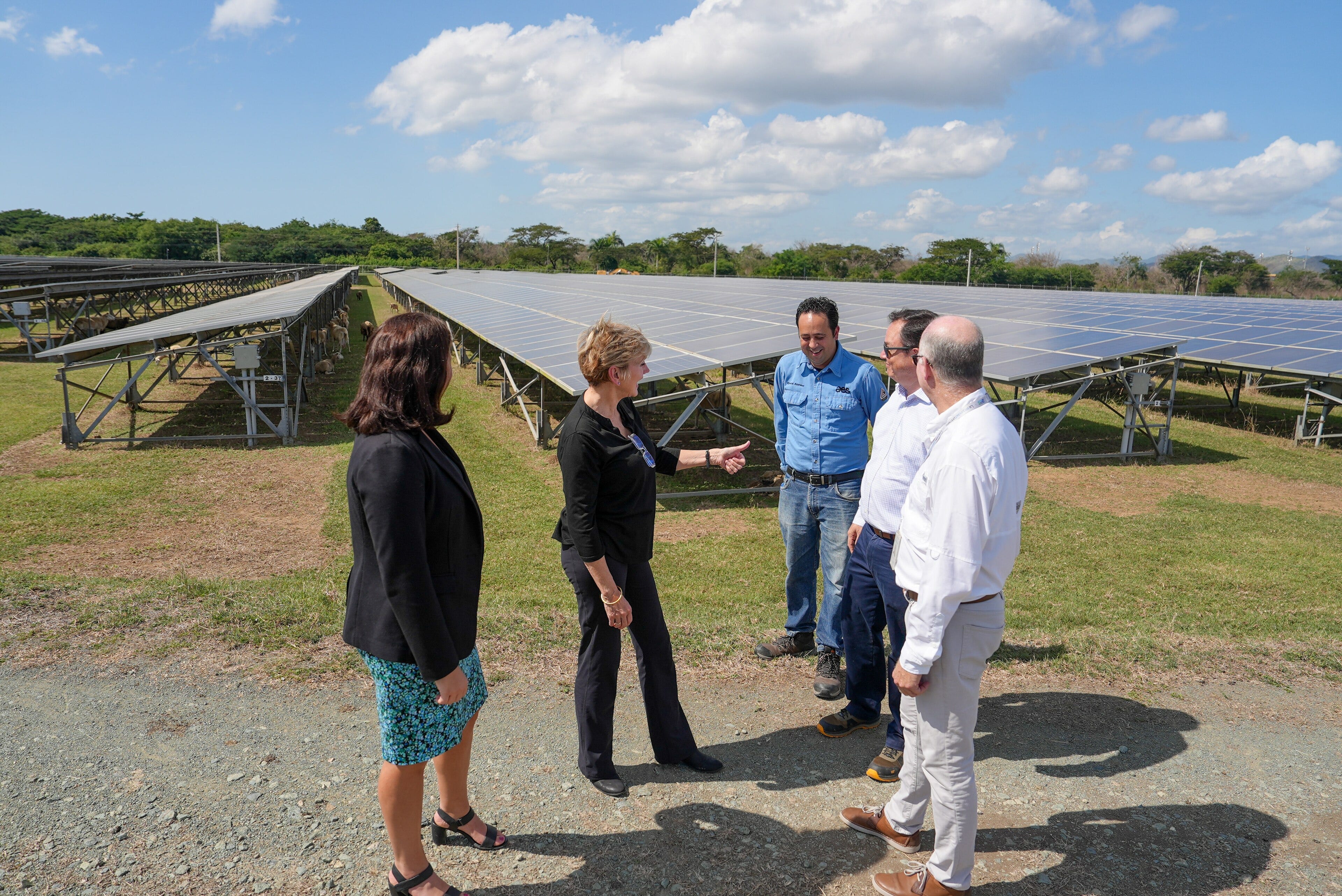
Muse spent several years providing technical support for efforts to keep the lights on in Puerto Rico. After Hurricane Maria, the Federal Emergency Management Agency agreed to spend $9.5 billion to repair the grid. After Fiona, Congress set aside another $1 billion specifically for rooftop solar and battery storage for vulnerable households, including low-income homes and people with disabilities.
“For Puerto Rico to have a resilient and reliable grid that matches what we have in the mainland — that’s the goal,” Muse told me.
.jpg)
Unfortunately, the goal still isn’t fully realized. Billions of dollars in Hurricane Maria recovery funds remain unspent. And now the Trump administration has canceled $800 million intended for solar and storage.
“They still don’t have what can credibly be called a reliable power system,” Muse said.
Muse was watching the Super Bowl on Sunday, and she was thrilled when Bad Bunny started singing “El Apagón.” She too posted on Bluesky.
“Bad Bunny’s done it well for years,” she wrote approvingly.
Did most viewers see Bad Bunny scale a utility pole and think blackouts, climate change, solar power? No, of course not. But probably a bunch of folks not already familiar with the song (like me!) looked it up and learned some stuff. There’s also been lots of media coverage the last few days of “El Apagón” and its significance.
The value to the climate discourse is even greater given the broader political context: Bad Bunny has been one of the loudest voices in the entertainment world standing up to Trump’s racist immigration raids. At the Grammys, he began one of his acceptance speeches by saying, “ICE out!” To close the halftime show, he named every country in North and South America while holding a football with the inscription, “Together, we are America.” Predictably, Trump and the MAGA crowd freaked out.
The Super Bowl broadcast is already one of the biggest platforms in American public life. This year, that was more true than ever.
So thank you to the NFL for sticking with Bad Bunny, despite the inevitable backlash — and thank you Bad Bunny for making climate justice part of the conversation.
Oh, about those Super Bowl ads

I watched most of the Super Bowl ads, and I’m sorry to inform you there was nothing encouraging from a climate or clean energy standpoint.
Unlike the good old days of February 2022 — when the Super Bowl featured five car commercials focused on electric vehicles, including one that actually used the phrase “reduce our carbon footprint,” one that promised “no greenwashing” and another that included electricity crackling through Arnold Schwarzenegger’s veins — this year was was an EV desert. There were four auto industry ads, none of which made much effort to market vehicles that don’t burn gasoline.
The only minor exception was Volkswagen, whose 30-second spot included a fleeting shot of an electric minivan. Toyota spotlighted a crossover SUV available as a regular hybrid or a plug-in hybrid. As I’ve written previously, hybrids are better than gas-only cars but not true climate solutions.
The rest of the ads weren’t any better.
For instance, I counted about a dozen ads touting artificial intelligence tools, which are fueling a data center building boom. Without getting into a long discussion about the value of AI, there’s no question that data center development is unleashing a rush to build polluting gas plants. And even when tech companies choose renewables, they may be making it harder for the rest of us to ditch fossil fuels. Amazon just outbid an electric utility for a massive solar project in Washington state.
So as much as I liked “The Office,” I didn’t enjoy the ad that put Brian Baumgartner (Kevin the accountant) back behind a desk, more productive than ever thanks to AI. I found myself wishing that some philanthropist — whoever wants to take over for Bill Gates, maybe — had paid for a climate-themed ad, like Science Moms did last year.
No such luck. Fans were, however, treated to a sports betting ad that featured Kendall Jenner taking off in a private jet.
The Seattle Seahawks beat the New England Patriots, 29-13. About 125 million people watched, according to Nielsen.
On social media, the halftime show scored billions of views.
In other news
Trump report:
The Trump administration is on the verge of overturning the “endangerment finding,” which allows the federal government to regulate greenhouse gases as pollutants. (Lisa Friedman and Maxine Joselow, New York Times)
A judge ruled that the Trump administration’s fake climate science panel violated federal law by flouting transparency rules. (Hayley Smith, L.A. Times)
A new poll finds that more than half of right-leaning voters support large-scale solar, not that Trump is listening. (Ysabelle Kempe, Canary Media)
The power grid:
It’s not just federal land — the Trump administration is blocking hundreds of wind and solar farms on private property. (Brad Plumer and Rebecca F. Elliott, New York Times)
Offshore wind is getting all the attention, but a combination of local opposition, disappearing tax credits and the Trump administration’s refusal to grant permits has caused onshore wind development to grind to a halt. (Dan Gearino and Anika Jane Beamer, Inside Climate News)
Lithium-ion batteries once again got cheaper in 2025. It’s amazing how they keep doing that! (Dan McCarthy, Canary Media)
Electric vehicles:
“It’s been about a month since we were last together. Now, every time I climb back into my Ford Mustang Mach-E, I can’t stop thinking about you.” A Wall Street Journal columnist tried a Chinese EV. She fell in love. (Joanna Stern, WSJ)
Turkey’s share of new vehicle sales that are battery electric is almost as high as California’s. (Ajit Niranjan, the Guardian)
Amazing new study: For every additional 200 electric cars in ZIP codes across California, unhealthy nitrogen dioxide emissions decreased by 1.1 percent. (Tik Root, Grist)
Western wildlife:
Trump is back to work building his border wall. New sections could be a death sentence for bighorn sheep along the California-Mexico border, cutting them off from their water sources. (Lila Seidman, L.A. Times)
In a major California Endangered Species Act success story, a wolf has come to L.A. County for the first time in more than a century. (Lila Seidman, L.A. Times)
California officials approved a controversial plan for professional hunters to kill all the mule deer crowding out native wildlife and plants on Catalina Island, part of the “Galapagos of North America.” (Lila Seidman, L.A. Times)
Around the West:
It's looking very much like the Colorado River states won’t reach a water-saving deal by a February 14 deadline. (Ian James, L.A. Times)
A bill in California would allow the state to sue oil and gas companies to cover rising insurance costs from climate disasters. (Laurence Darmiento, L.A. Times)
Meta is spending millions of dollars in Sacramento and other state capitals on TV ads to influence policy decisions about data centers. (Eli Tan, New York Times)
Meanwhile, in Milan Cortina
I wrote last week about Jacquie Pierri, the New Jersey-raised hockey player/green energy engineer currently playing defense for the Italian women’s team in the Winter Olympics. I’m happy to report that Italy “pulled off the unthinkable,” as Reuters put it, winning two games and reaching the women’s hockey quarterfinals for the first time.
Pierri and her teammates have a tough task ahead. They’ll take on the dominant Team USA on Friday at 12:10 a.m. Pacific time, airing later that day on Peacock.
A victory for Italy would be a stunning upset. But anything is possible. If we want to avert ever-more-dangerous climate change, we certainly have to believe that.
Meet Jacquie Pierri, your Winter Olympics climate hero

She grew up in New Jersey, built a career in clean energy and is playing hockey this month for the Italian women's team in Milan Cortina.
Until next time
(Forgive the typo: “Marve’s” should be “Marvel’s.”)
Big Bunny is exactly the kind of climate champion we need.
Bad Bunny was a change of pace, but the ads were disappointing. Advertising can be creative and inspiring, almost poetry in capturing symbols to tell a story in less than a minute. https://www.ama.org/marketing-news/the-best-advertisements-of-all-time-top-19-iconic-campaigns-across-media/ The game wasn’t very interesting, either. But hey, go Seahawks! See you next season.