


I originally published this story behind a paywall. Today I’m making it free for everyone.
Most of the time, my paywalled posts will stay paywalled. If you enjoy this kind of storytelling and want to help me do more of it, please consider a paid subscription.
This is Part 2 of a two-part series. Read Car Culture, Part 1: The Battle for Disneyland.
I didn’t expect to find many electric vehicles at last month’s LA Auto Show — not in Donald Trump’s America in 2025. I girded myself for a convention center packed with dangerously oversized gas-guzzlers marketed as symbols of rugged individualism.
Sadly, I was right. But there was plenty of stuff I didn’t see coming — some of it good, some less so.
I wasn’t prepared for all the Disney and sports cross-promotions. Or for Volkswagen’s attempt to capitalize on the Los Angeles wildfires.
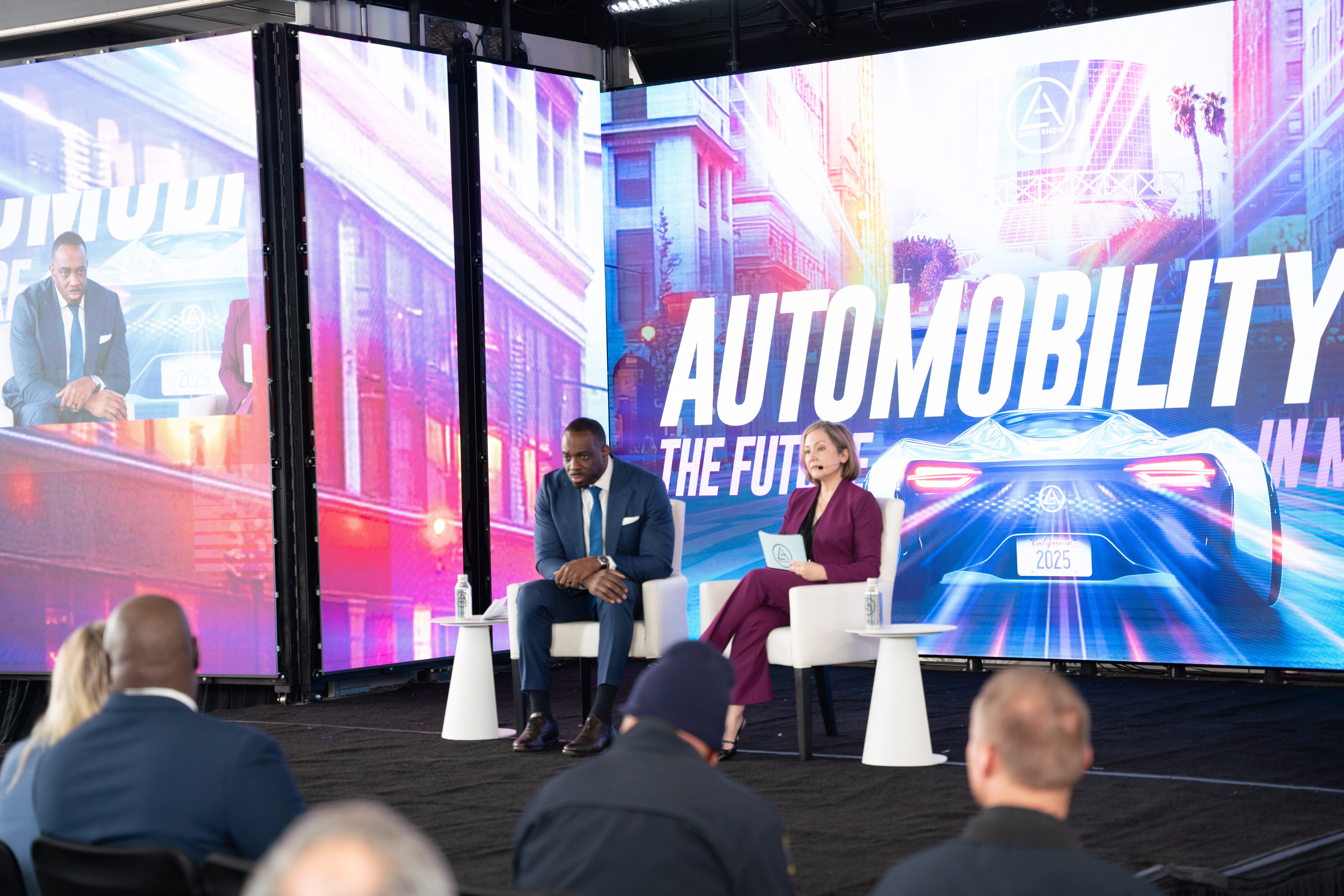
Most of all, I was surprised by California Transportation Secretary Toks Omishakin’s answer when I asked him whether it’s still possible to meet California’s goal of ending the sale of gas-only cars by 2035.
Requiring that 100% of newly sold cars be zero-emission by 2035 was Governor Gavin Newsom’s crowning climate achievement — a mandate that would spur progress not just here but around the world. So when one of his top appointees signaled in October that state officials would “rethink” the 2035 target, I was astonished.
Sure, the short-term outlook for EVs isn’t as strong as once hoped. Republicans have repealed federal tax credits, and President Trump is trying to block California’s clean car mandate. Still, why concede defeat so easily?
During a media Q&A, I asked Omishakin: Is California’s 2035 goal still achievable?
“I think so. But there’s no doubt that we’re facing headwinds,” he said.
He brought up Trump’s attempt to block California’s clean car mandate. The state is suing to maintain the mandate, but it’s not clear who will win.
No matter, Omishakin said, “the vision is still the vision. The goals are still the goals.”
“We’re full-speed ahead. We’re not backing off of our commitment to this. We really believe that we can achieve this, despite the headwinds. Despite the headwinds, we’re still as locked in as ever on the 2035 date,” he said.
“But we’ll continue to have those conversations about how to get there,” he added.
OK, so apparently California is not backing down. A different message than the one proffered in October by Lauren Sanchez, chair of the state Air Resources Board.
Discord within the Newsom administration? A game of good cop-bad cop with auto industry? A case of crossed wires? Your guess is as good as mine.
But I hope California manages to stick to 2035. Because given what I saw at the Auto Show, car companies need a strong push toward EVs.
Yes, EV specialists like Lucid and Rivian were present at the convention center. But I wanted to know how the major manufacturers were marketing themselves.
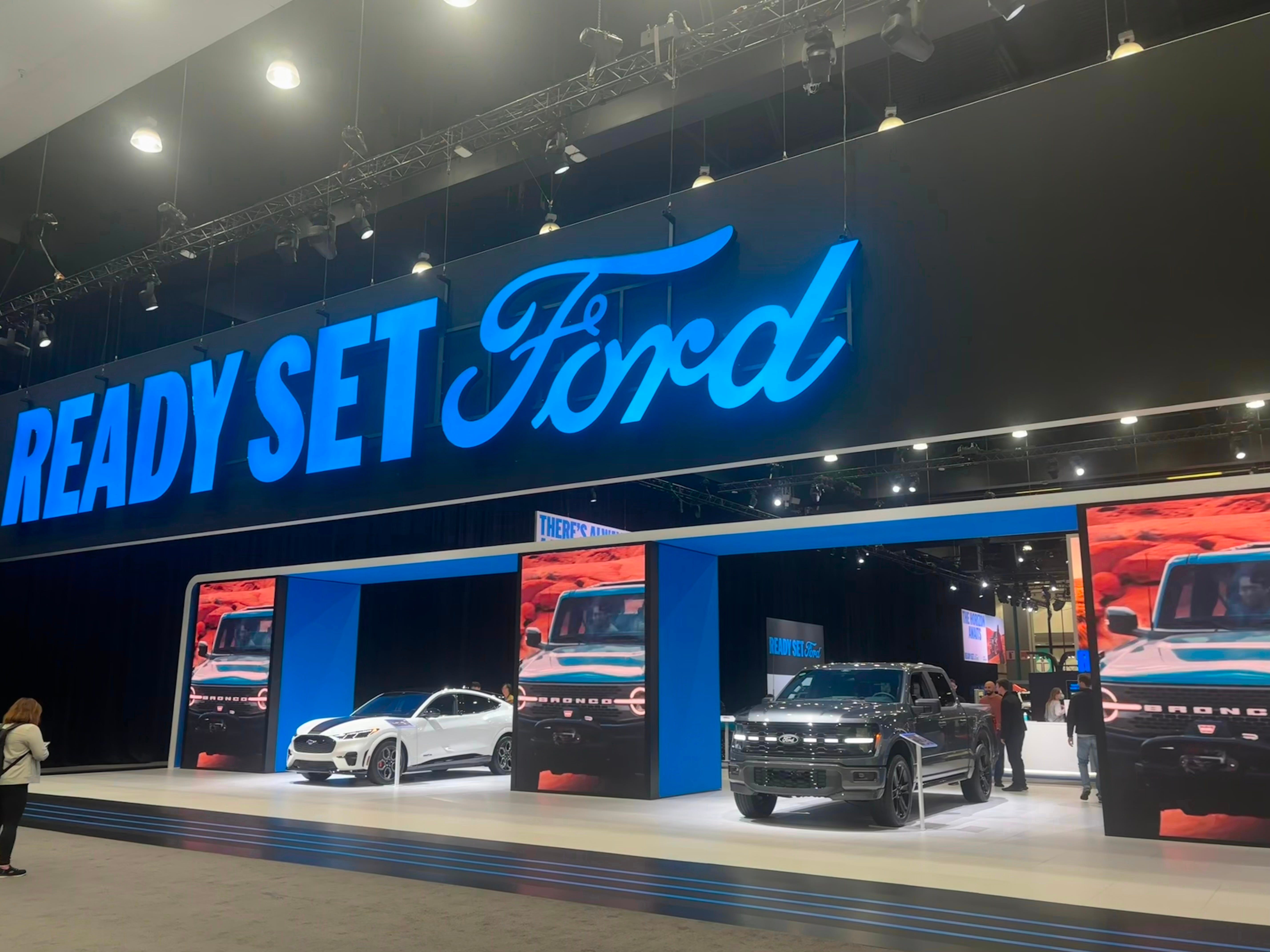
So I took a lap through the sprawling Ford exhibit, counting EVs. Out of 27 cars and pickup trucks on display, just two were fully electric: a Mustang Mach-E SUV and an F-150 Lightning pickup, which Ford has since stopped manufacturing.
Toyota was no better. Out of 38 vehicles on display, three were fully electric, despite a large sign touting the company’s “beyond zero” climate commitment.
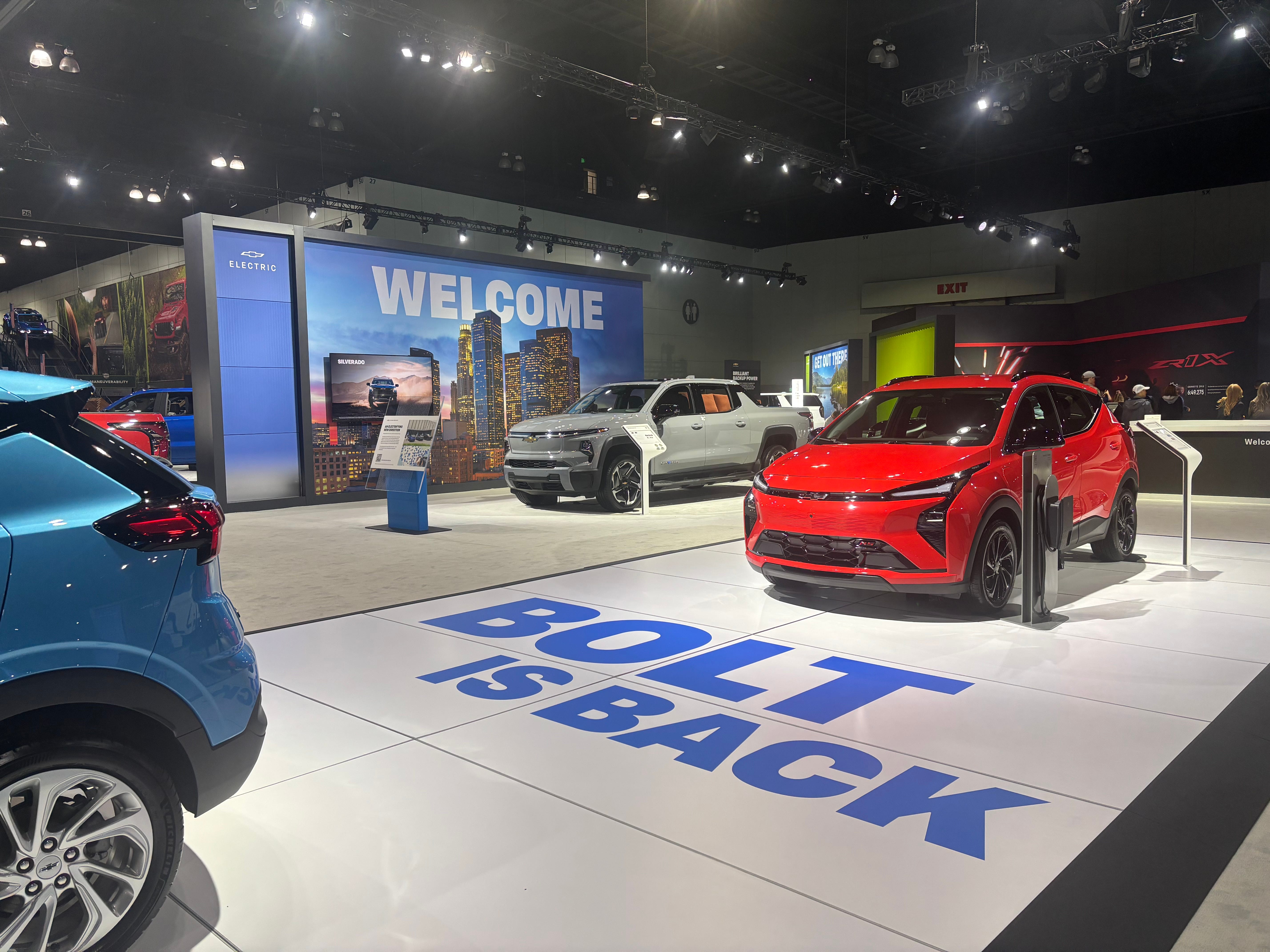
Rounding out America’s top-selling auto brands, I visited the Chevrolet exhibit and was pleasantly surprised. Chevy scored seven out of 31 on my test, and also featured detailed signs from its parent company General Motors explaining how you can use your EV battery to power your home during a blackout.
Otherwise, the picture was grim. At crowded press conferences, electric cars were a sideshow at best. Automakers rolled out SUVs that looked like tanks; a Kia designer proudly described the new Telluride as “unapologetically boxy.” Companies promoted their vehicles with clips of drivers navigating backcountry terrain, from rutted desert roads (with Joshua trees in the background) to stunning red-rock canyons. One video featured so much perfectly placed wildlife that I wondered if it was AI.
Meanwhile, guests lined up to test-drive off-road Jeeps on an indoor obstacle course. Toyota celebrated its 50th season sponsoring the Lakers by filling a pickup truck with golden basketballs. Kia touted its sponsorship of the 2026 FIFA World Cup, Honda its sponsorship of the 2028 Olympics. Kia leveraged a partnership with Disney, showing off ways to customize its vehicles’ digital dashboards with characters from franchises including “Frozen” and “Star Wars.”
This was car culture. This was America. And EVs were largely absent.
Nothing left me feeling more disoriented than the show put on by Volkswagen, whose 2015 emissions cheating scandal might as well be ancient history.
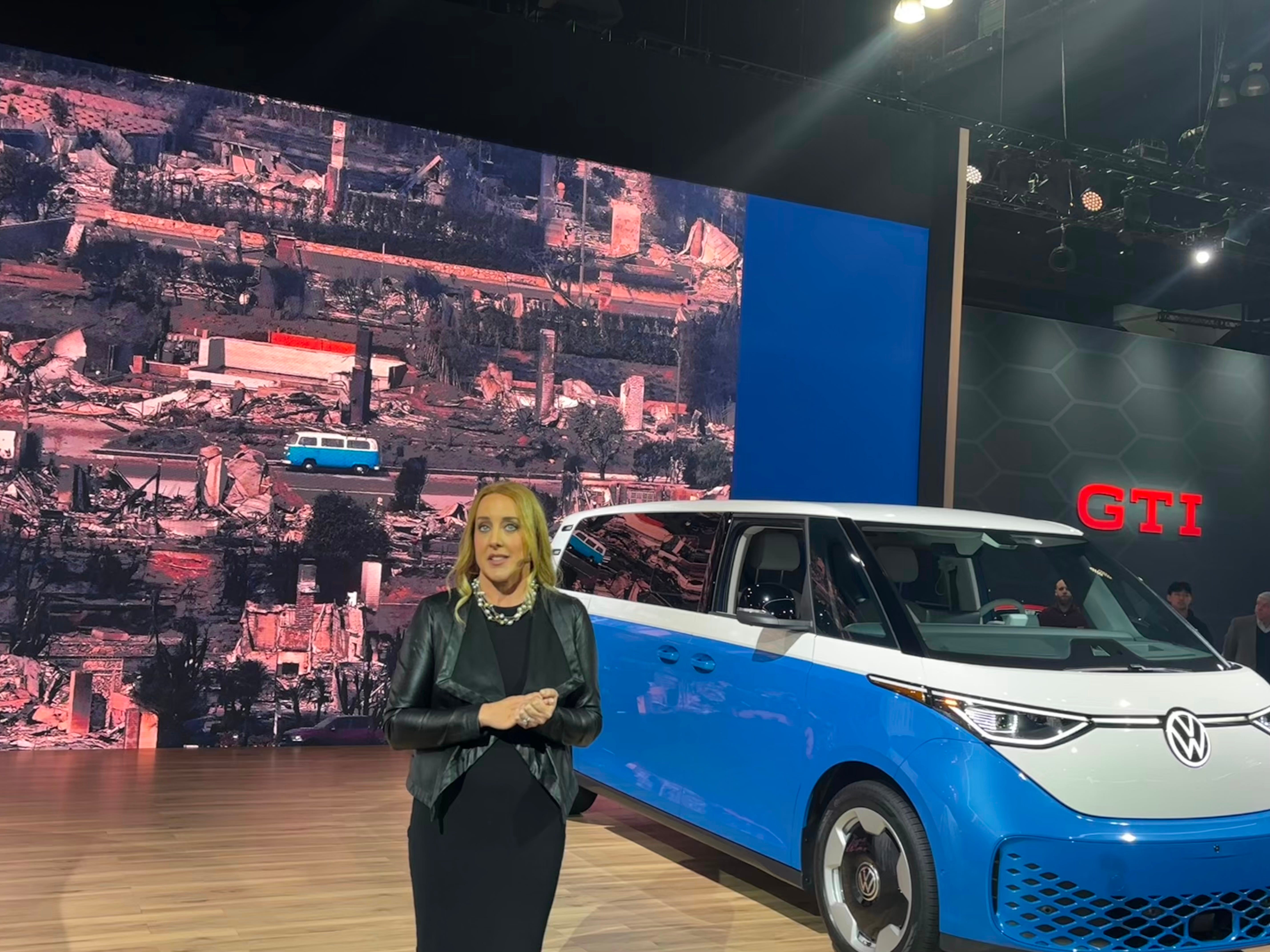
VW executive Rachael Zaluzec began by describing Los Angeles as “the heartbeat of car culture in America.” She soon brought up the fires that devastated L.A. in January, and in particular an image that “stopped us all in our tracks.”
“Many of you will remember a photograph that quickly became iconic,” she said. “But it wasn’t an image of tragedy. It was an image of hope.”
What was in this photo?
“A blue-and-white Type 2 Volkswagen bus, seemingly unaffected [by the Palisades fire]. Its color a beacon, standing out among the blackened husks of what were actually formerly people’s homes in the Pacific Palisades,” she said. “In a moment of what was really otherwise unimaginable loss, that image reminded us of resilience.”
Was I losing my mind? Thousands of people had lost their homes — dozens had died — in wildfires worsened by fossil fueled climate change. The biggest source of climate pollution in California is transportation, mainly cars and trucks. And Volkswagen was trying to use the wildfires for good publicity? And I was standing in a crowd of people smiling and cheering like it was OK?
Kudos to VW for restoring the vintage blue bus in the photo (which actually suffered serious fire damage) so that its owner could keep driving her beloved vehicle.
But it says a great deal about U.S. culture — about the priorities and perspectives of consumers, executives and the media — that Volkswagen would attempt a PR stunt like this, let alone get away with it. Sure enough, the company earned glowing stories from news outlets including the Associated Press, the Detroit Free Press and the L.A. Times. None of them mentioned climate change.
As I wandered the Auto Show feeling lost, I ran into Dave Reichmuth from the Union of Concerned Scientists. He tried to cheer me up, making the sensible argument that EV demand will keep rising as prices drop. Before federal tax credits were eliminated, EVs and plug-in hybrids made up about 25% of new car sales in California.
“The question is how quickly we get back to 25%,” Reichmuth said.
I’d sleep easier if I felt confident California’s next governor would fight for 100% clean cars by 2035 — a tenuous prospect, given that none of the candidates are eager to talk climate change right now. It’s already clear that California won’t hit its interim goal of 35% zero-emission vehicle sales in 2026. We need to pick up the pace.
Ultimately, I’m optimistic the U.S. will break its fossil fuel addiction. Solar and wind and batteries are too cheap to beat. The good guys will prevail, eventually.
As for our car addiction? I’m less certain.
When I wrote last week about the harms caused by motor vehicles, and by car-centric urban planning — the tens of thousands of annual deaths; the astoundingly deadly air pollution; the communities torn apart by freeways; the noise, the traffic, the road rage, the hot pavement, the lack of space for parks and housing, and more — I realized how few people truly understand the extent of the damage. Myself included.
You can’t solve a problem unless you admit you have one. And most folks don’t see car culture as a problem. They love their cars.
Car companies are determined to keep it that way. Big Oil might have the Republican Party in its pocket, but the auto industry has partnerships with Disney, the Lakers and the Olympics, among countless other sports and entertainment icons. And if you love the great outdoors? Then you’ll love these SUVs. The marketing genius is real.
Political winds shift. Economic fundamentals change too. But our cultural narratives? The stories we choose to believe about who we are as Americans?
If you can control those, you’re in the driver’s seat.
Car Culture, Part 1: The Battle for Disneyland

Should we drive electric vehicles or try to stop driving? "Life After Cars" meets the Happiest Place on Earth.