

Full video: California's next governor talks climate
My conversation with the candidates.

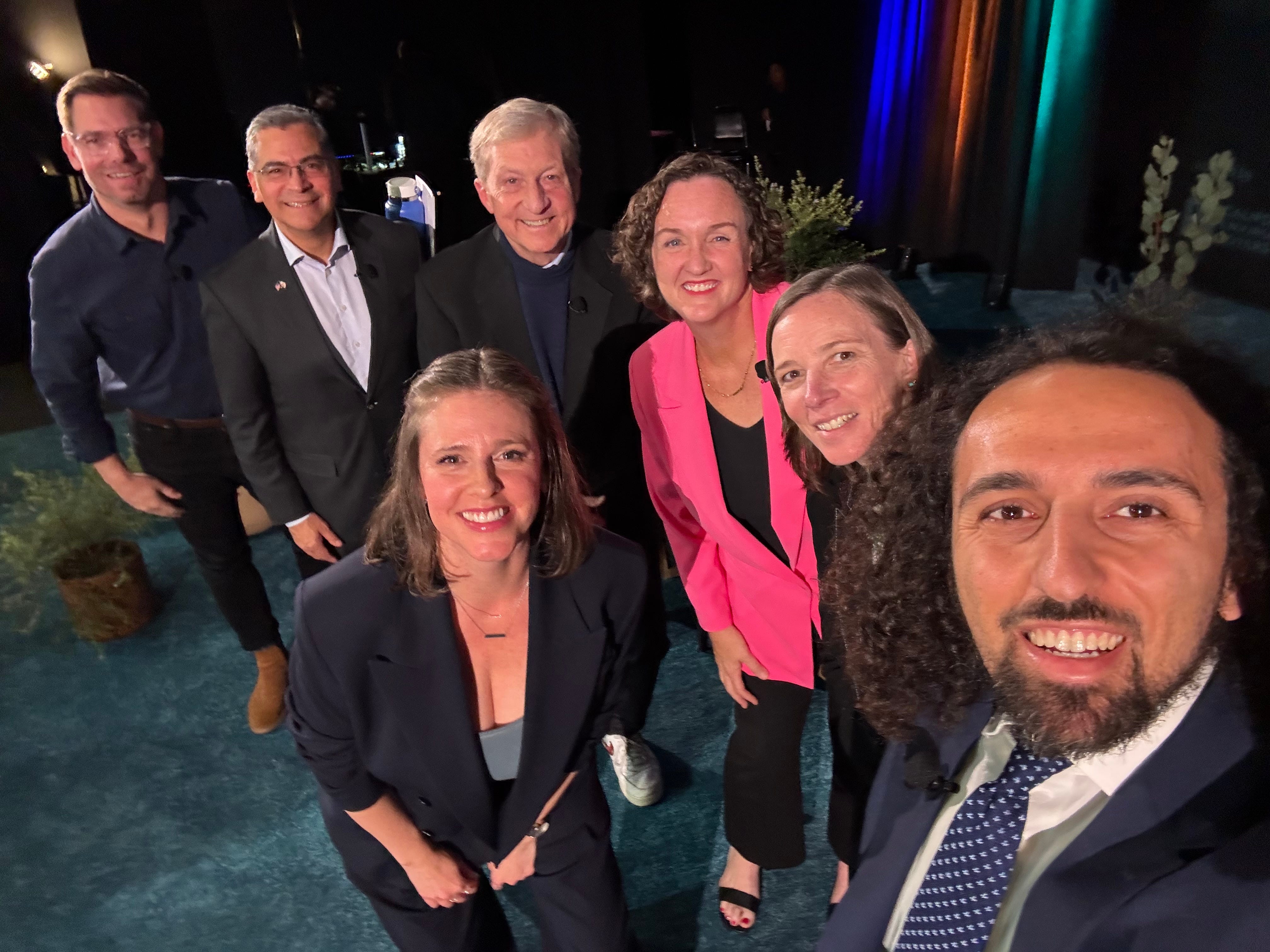
On Wednesday, I sat down with the leading candidates to replace Gavin Newsom as California governor for a wide-ranging conversation about how they’d confront the climate crisis. It was an amazing opportunity — and also a bit surreal, knowing that meanwhile, in Minnesota, agents of the U.S. government were killing and terrorizing innocent people. I’m grateful that the candidates — Xavier Becerra, Katie Porter, Tom Steyer and Eric Swalwell — still made time to talk climate.
You can watch full video above, starting with remarks from Mary Creasman, CEO of California Environmental Voters, which hosted the forum. Her group invited the top six candidates based on polling and ended up with all Democrats after the top-polling Republicans, Chad Bianco and Steve Hilton, declined to participate.
I have lots of thoughts on how the candidates did; I’ll share my unvarnished analysis next week. For now, watch the video and let me know what you think. As always, the comments are open to paid subscribers who want to discuss.
And because everyone loves a good selfie:
Way more traffic deaths
This headline yesterday stood out to me: Waymo under scrutiny after hitting child near Santa Monica elementary school. Per the L.A. Times article:
The child sustained minor injuries, Waymo said. After being struck, the child stood up and walked to the sidewalk, where witnesses called 911…
“The event occurred when the pedestrian suddenly entered the roadway from behind a tall SUV, moving directly into our vehicle’s path,” Waymo said in a statement. “The Waymo Driver braked hard, reducing speed from approximately 17 mph to under 6 mph before contact was made.”
Sometimes I wonder: What if every traffic death caused by a human driver generated the same news coverage as every incident caused by an autonomous vehicle? Last year in Los Angeles — 10 years after the city set a goal of eliminating traffic deaths by 2025 — nearly 300 people died in traffic collisions (again per the L.A. Times).
Obvious a driverless car hitting a kid is bad. New technologies deserve scrutiny. But we should strive to scrutinize the technologies and ways of life to which we’ve grown accustomed — and the horrors they inflict every day — just as rigorously.
On a similar note, I find myself strangely underwhelmed whenever I read the latest glowing reports about the world’s largest wildlife crossing, which is being built above the 101 Freeway at a cost of $114 million and should be finished later this year (once again per the L.A. Times). The wildlife crossing is wonderful; I’m glad it’s coming to fruition. But why is it so hard to generate the same level of attention and enthusiasm and funding for pedestrian and biker and driver safety?
Transportation continues to be the biggest source of climate pollution in California and nationally. Electric vehicles are an important part of the solution, but they aren’t the only solution. And nor is climate change the only problem.
Car Culture, Part 1: The Battle for Disneyland

Should we drive electric vehicles or try to stop driving? "Life After Cars" meets the Happiest Place on Earth.
In other news
Energy and water:
Federal regulators approved a massive pumped storage project in Washington state. It could be America’s first new pumped storage facility since 1995. (Julian Spector, Canary Media)
California officials are preparing to make a consequential decision for the health of the Sacramento-San Joaquin River Delta. (Ian James, L.A. Times)
Sea level rise:
A San Francisco Bay Area county could be on the hook for billions of dollars to protect a frequently flooded road connecting a wealthy coastal community to the mainland. (Tara Duggan, San Francisco Chronicle)
You can finally drive through Big Sur on Highway 1 after a yearslong closure. But the road is losing a battle against climate change. (Grace Toohey, L.A. Times)
On our public lands:
A sign at California’s Muir Woods National Monument explaining that redwoods soak up planet-warming gases was removed by the Trump administration. It’s one of many ways the National Park Service is silencing science and history. (Maxine Joselow and Jennifer Schuessler, New York Times)
The U.S. Forest Service is rewriting rules to try to make it easier to drill for fossil fuels on federal lands. (Jake Bolster, Inside Climate News)
Meanwhile, in Europe:
Electric vehicles outsold gas-only cars for the first time in Europe in December, although hybrids were still the top seller. (Iulian Dnistran, InsideEVs)
Amsterdam just banned advertising for fossil fuels and meat products in public spaces. (Ellen Ormesher, DeSmog)
Way More Traffic Deaths. Sammy, I really enjoyed reading your comments on traffic accidents and on the facet that motored vehicles is not the only way to get place to place. I appreciate your pushing the public to use other forms, rather than jumping in the car every time they want to go somewhere. I turn 73 years old in 6 months, and I think my health would be better if I jumped on my bike to go short distances more than if I jumped in my car for that same trip. I have been "bitching at myself" to use my bike more, but laziness and habit are strong incentives (It took me a decade to quit smoking using this same tactic).
I did speak against the proposed BESS facilities in Pomona and I believe the group, Clean and Green Pomona did have an influence on the City Planning Commission. There is a BESS near Parkfield named California Flats, there was a problem there and they needed to evacuate a 2-mile radius to keep people safe. I think it was 5 homes and 2 businesses. If that emergency happened in Pomona, it would be 15,000 homes and hundreds of businesses. These BESS facilities are operated remotely and are connected to the Grid; they can be located miles from communities connected by wires. I thought you would appreciate the update.