

A new climate movement takes shape
These fossil fuel protests started in Los Angeles and have spread across the country.

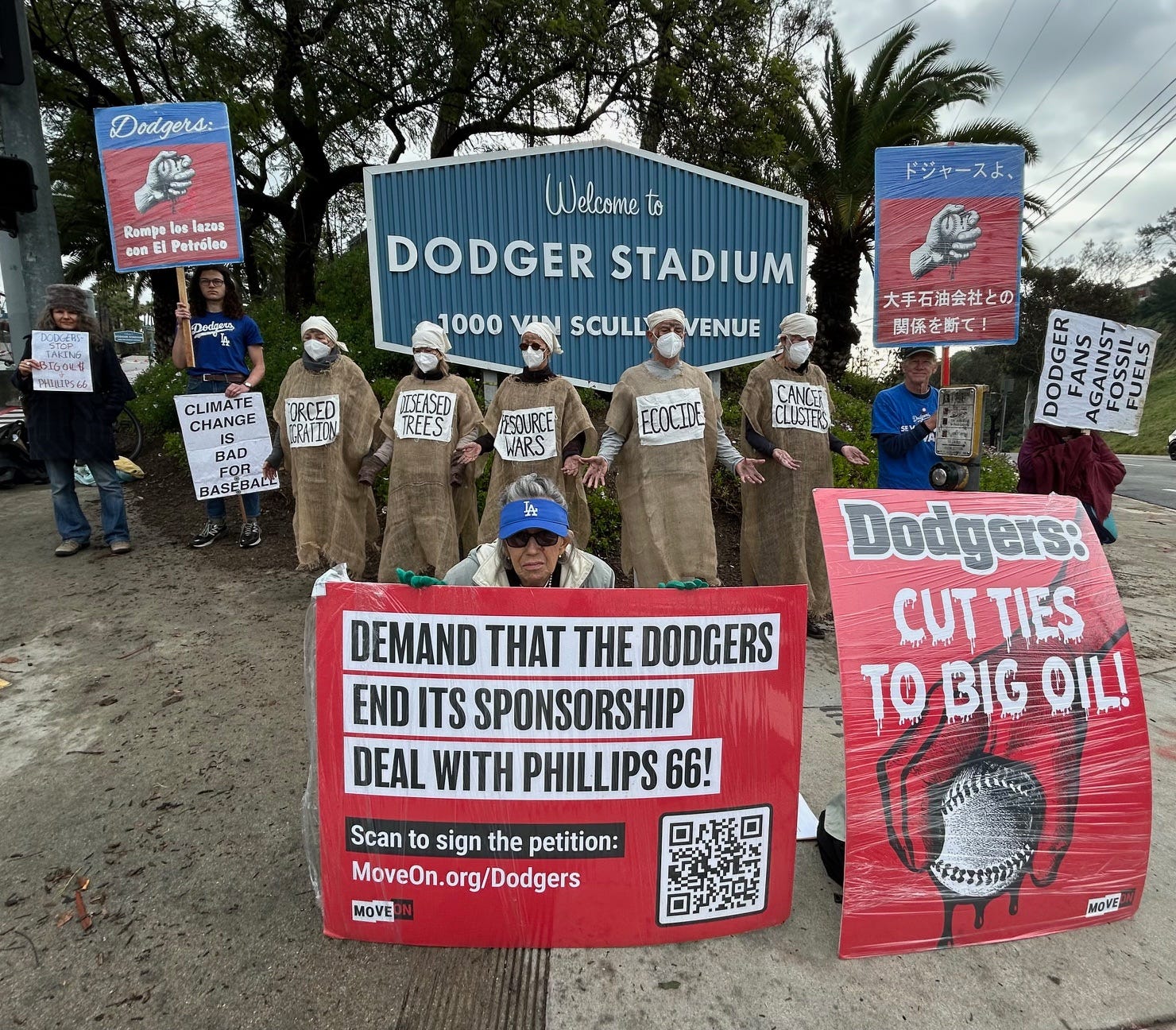
As the Dodgers got to work at their Arizona spring training facility on Tuesday — Shohei Ohtani slinging 98 mph fastballs, Hyeseong Kim grinning through push-ups, manager Dave Roberts making a motivational speech — a dozen climate protesters gathered outside Dodger Stadium in Los Angeles. Some of their signs read:
Climate Change Is Bad for Baseball
Dodger Fans Against Fossil Fuels
Dodgers — Stop Taking Big Oil $
This had happened before. Ever since I wrote a June 2024 column urging the Dodgers to end a sponsorship deal with oil giant Phillips 66, activists had regularly gathered at the corner of Stadium Way and Vin Scully Avenue to lament the team’s refusal. Nearly 30,000 people had signed a petition calling on the team to cut ties with Phillips, owner of the 76 gasoline brand, a longtime Dodgers advertiser.
But on Tuesday, something was different: L.A. activists were joined by demonstrators in nine other cities, from sea to shining sea. In San Francisco, Sacramento, St. Louis, Cleveland and Boston, they rallied at stadiums whose teams accept ad dollars from oil and gas companies. Protests took place at:
Oracle Park (team: San Francisco Giants; sponsor: Phillips 66)
Golden 1 Center (Sacramento Kings; BP)
Busch Stadium (St. Louis Cardinals; Phillips 66)
Progressive Field (Cleveland Guardians; Marathon Petroleum)
TD Garden (Boston Celtics; Gulf Oil)
Climate activists also showed up at four other stadiums:
Lincoln Financial Field, home to the NFL’s Philadelphia Eagles, whose sponsors include NRG Energy, a utility that gets most of its power from fossil fuels
Atlanta’s Mercedes-Benz Stadium, which will host games during the 2026 FIFA World Cup, a tournament whose major sponsors include Saudi Aramco
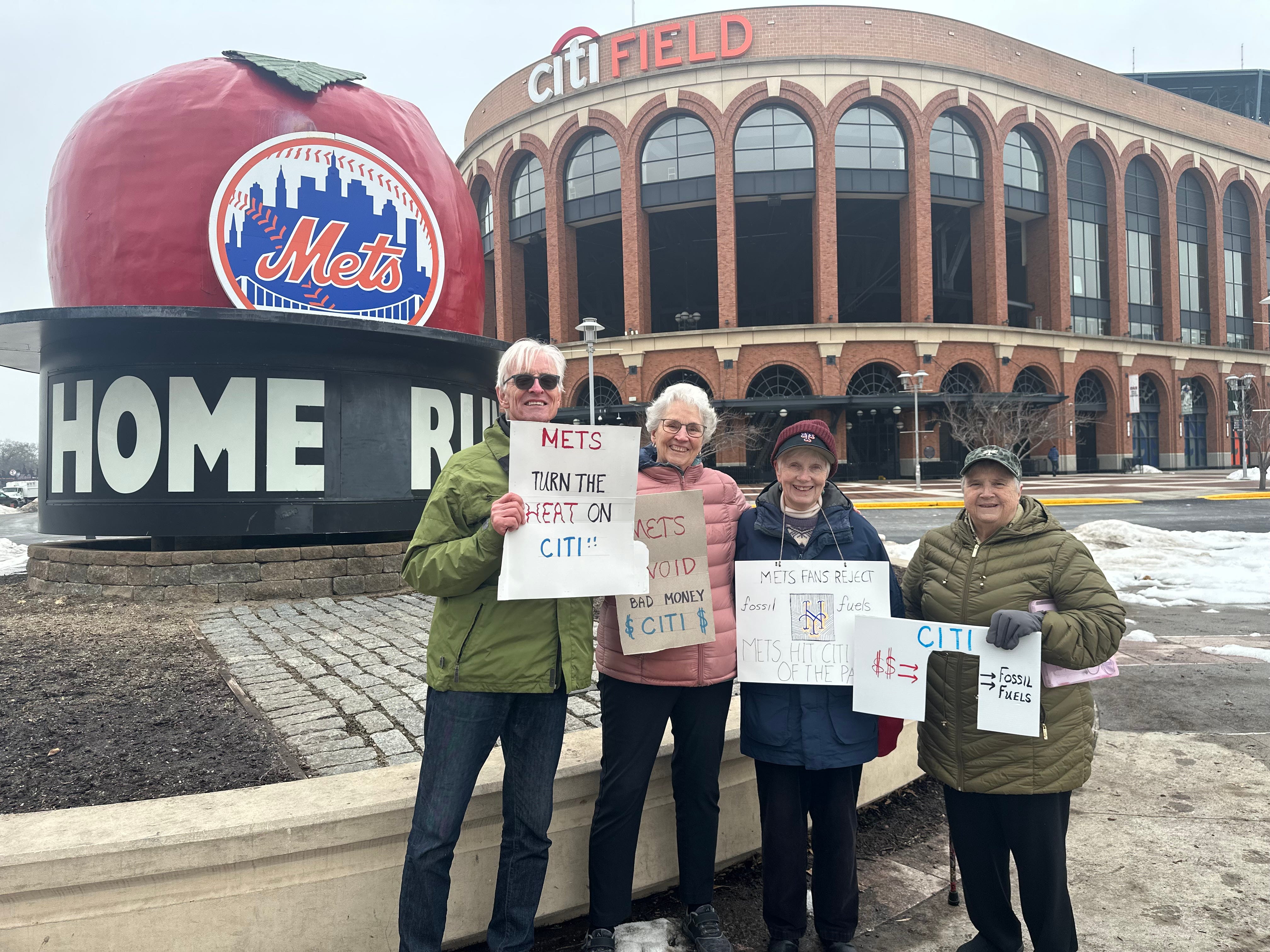
Citi Field (home to MLB’s New York Mets), whose naming rights are paid for by Citigroup, the world’s third-largest fossil fuel funder in 2024
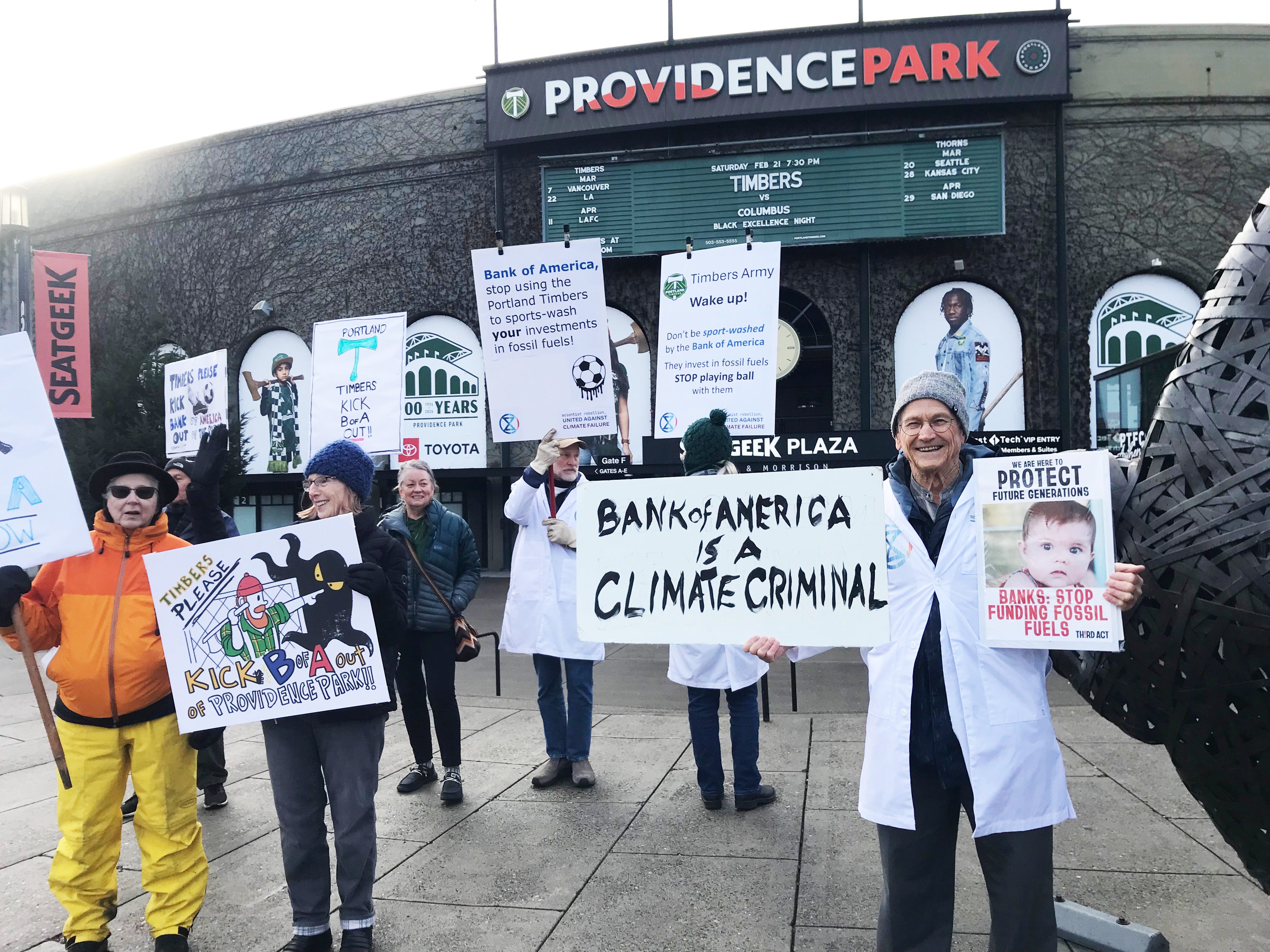
Providence Park, where Bank of America — the world’s second-largest fossil fuel funder in 2024 — is a sponsor of Major League Soccer’s Portland Timbers
Some of the rallies were as small as one person. The biggest had a dozen. But the key takeaway was the geographic reach. As far as I’m aware, this was the first national day of protest against fossil fuel advertising in U.S. sports history.
“Our chief aim today is simple,” lead organizer Zan Dubin told the crowd at Dodger Stadium. “One, we do want to stigmatize sportswashing. And two, we want to inspire.”
Dubin has worked relentlessly to pressure the Dodgers to dump Phillips 66, enlisting support from the Sierra Club Angeles Chapter as well as state Senator Lena Gonzalez, who wrote to Dodgers owner Mark Walter imploring him to end sponsorships with oil companies. In a recent press release, Dubin included a quote from Sierra Club chapter director Juanita Chavez, daughter of legendary labor leader Dolores Huerta.
“The Dodgers rejected stadium cigarette ads decades ago for good reason. Bans on tobacco advertising lead to fewer people smoking,” Chavez said. “The team showed a similar responsiveness to fans last year, albeit too little and too late, by turning away federal immigration agents and pledging funds to help immigrant families.”
“We’re asking Dodger owners to show the same concern for their fans’ health and our planet by refusing to allow Big Oil to advertise in their stadium,” she added.
The campaign to end fossil fuel advertising in sports hasn’t yielded any wins yet, at least not in the U.S. But big movements always start small, with determined bands of righteous people going up against long odds and entrenched injustices. On Tuesday, activists endured pouring rain in San Francisco. In Atlanta, a protester brought his 83-year-old mother, who held a sign asking, “Did You Know There Is a Climate Crisis?” In New York, three nuns read, “A prayer for our earth,” a selection from Pope Francis’ climate change encyclical “Laudato Si.”
In L.A., protesters raised signs in English, Spanish and Japanese — an appeal to the Dodgers’ multicultural fan base. Several passing drivers honked in support. One guy parked, got out of his car and stopped to sign the petition.
In another encouraging sign, the L.A. Times sent a photographer to the protest and ran a picture in Wednesday’s paper. I hadn’t expected the Times to keep covering the anti-Phillips 66 campaign after I left the paper, so that was cool to see.
When I asked Jonah Henry, an activist wearing a Dodgers T-shirt, why he joined the protest, he called the team “one of the most well-respected institutions in the city of Los Angeles, across race, across class, across political party.”
“By advertising for Phillips 66, the Dodgers are giving public legitimacy to a fossil fuel industry that is actively destroying our planet and destabilizing our democracy, doing everything in its ability to delay the renewable energy transition,” he said.
I also spoke with Lisa Hart, who runs the L.A. Neighborhood Council Sustainability Alliance. While admitting she “couldn’t care less about baseball” — she called it “one of the most boring sports imaginable” — she said she’s frightened by how oil and gas companies use teams like the Dodgers to ingratiate themselves with the public.
“This is so insidious. It’s like baseball, apple pie and fossil fuels,” she said. “We have to bring it to people’s awareness.”
Some athletes are raising awareness, too. Just before this month’s Winter Olympics began in Italy, a climate group unveiled a petition signed by more than 21,000 people, — including many pro athletes, among them gold medal-winning U.S. skier Alex Hall — calling on the International Olympic Committee to reconsider accepting fossil fuel sponsorships. A few days later came an open letter, this one signed by 88 Olympic and Paralympic athletes, urging the IOC to ban fossil fuel sponsorships.
When will the first domino fall? I don’t know.
But the question needs to be “when,” not “if.” Wonderful as it is that solar and wind power are cheaper than oil and gas, the fossil fuel industry won’t be defeated on cost alone — not fast enough for a stable climate, anyway. The industry will live or die on political and cultural battlefields. In statehouses and stadiums.
In other news
The Southland:
Last year, Southern California air quality regulators rejected a proposal to phase out gas-powered appliances after being overwhelmed by more than 20,000 public comments in opposition. It turns out many of those comments were generated by artificial intelligence. (Hayley Smith, L.A. Times)
After the Eaton fire, Altadena residents asked SoCal Edison to bury electric lines to limit wildfire risk. Now Edison wants some residents to pay more than $20,000 to connect their homes to newly buried lines. (Melody Petersen, L.A. Times)
After decades of local pressure, California plugged a horribly leaky South L.A. oil drilling site whose operators refused to clean it up. (Tony Briscoe, L.A. Times)
On our public lands:
Several groups are suing the Trump administration to restore information about civil rights and climate change at national parks. (Brady Dennis, Washington Post)
President Trump has nominated an executive at a parks concessionaire to lead the National Park Service. The concessionaire was previously involved in a nasty legal dispute involving Yosemite. (Kurt Repanshek, National Parks Traveler)
Three of Theodore Roosevelt’s great-grandsons are urging Republican senators to block mining in a national forest established by Roosevelt in one of his last acts as president. (Maxine Joselow, New York Times)
More Trump stuff:
Trump is ordering the Department of Defense to buy electricity from coal plants, which will definitely benefit the military. (Hayley Smith, L.A. Times)
California and 12 other states are suing the Trump administration over billions of dollars in canceled federal energy funding, including money set aside by Congress for hydrogen and energy efficiency. (Hayley Smith, L.A. Times)
ExxonMobil and other firms are bankrolling Trump’s “Freedom 250” propaganda bash for America’s 250th birthday. (Judd Legum, Popular Information)
Around the West:
Federal officials now project that Lake Powell will “most probably” drop below minimum power pool — meaning the dam won’t be able to produce hydropower — before the end of 2026. (Jonathan P. Thompson, The Land Desk)
Scientists haven’t seen this little snow in the West in decades. One reason why: Since December 1, there have been 8,500 daily high temperature records broken or tied in the West. (Dorany Pineda and Seth Borenstein, Associated Press)
New Mexico lawmakers rejected a bill that would have required net-zero climate pollution by 2050. Seven Democratic senators joined with Republicans to kill the bill. (Dan Boyd, Albuquerque Journal)
Ten of the 30 MLB stadiums have solar panels installed on them. The first to do so was the San Francisco Giants for the 2007 All-Star game. The Padres have the largest array in the MLB at 336 kW. Fenway Park has solar thermal panels that provide hot water at the stadium. The Dodgers are Bums when it comes to solar power. Maybe their new owners will do better.
"As far as I’m aware, this was the first national day of protest against fossil fuel advertising in U.S. sports history."
I can promise this won't be the last. In the dead of winter, protesters came out in ten cities. When the weather improves this summer, we'll do it again.